

The ROI of Creative Automation: Efficiency is the easy half
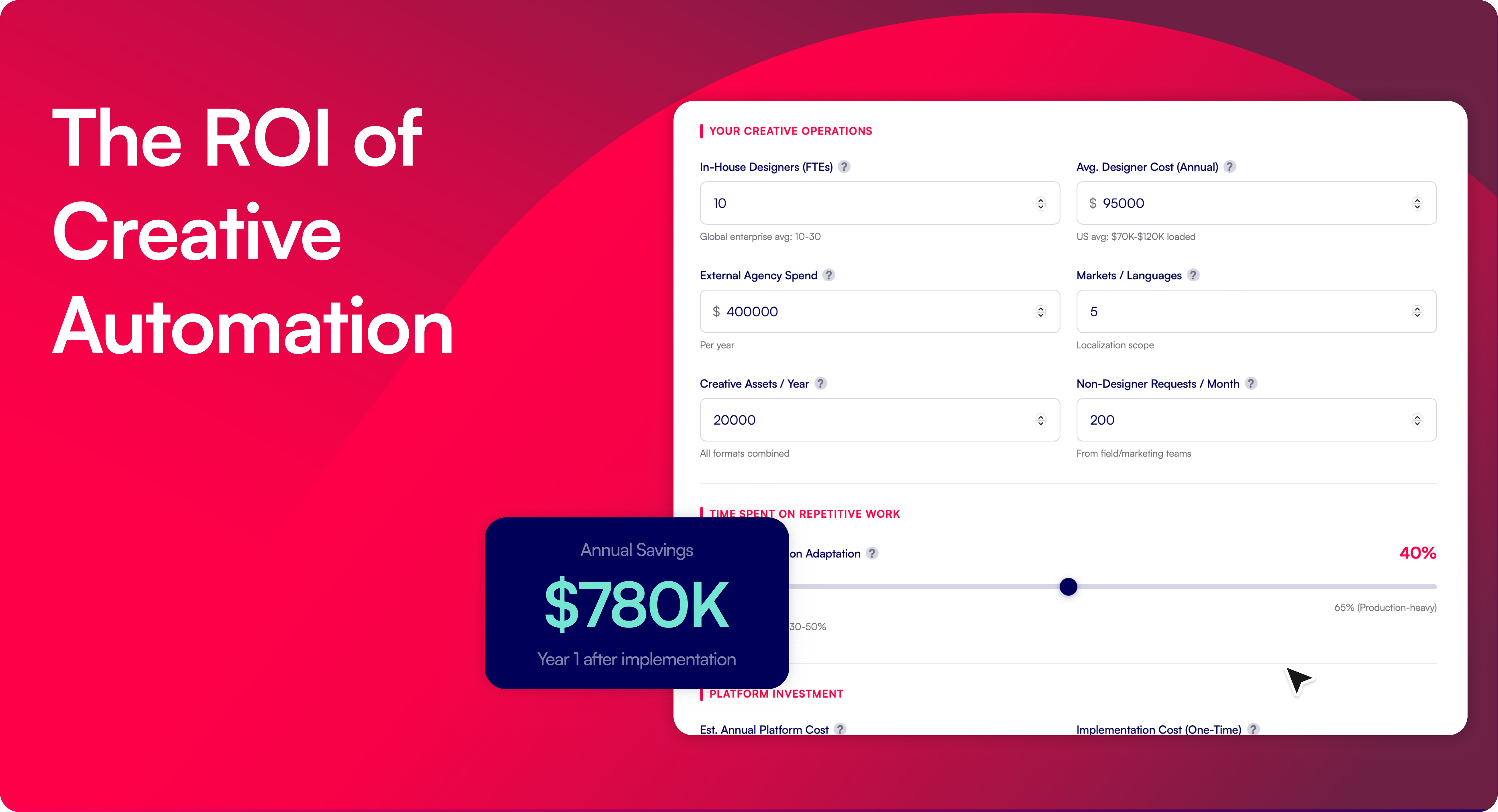
Efficiency is the easy half of creative automation ROI. More speed, less cost, fewer people, all of it real and all of it measurable. The half that actually decides the business case is harder: what does it cost you when production goes off-brand?
Payback comes in the first quarter
Putting a number on digital transformation has always been awkward. The investment lands on day one, while the return builds over months, shaped by change management, adoption curves and second-order effects nobody forecasts in the original spreadsheet.

Which can make the business case feel harder to pin down than it actually is. For most teams, the efficiency gains alone pay back the investment inside the first quarter, often sooner. That is the floor, not the ceiling. The first quarter clears the cost, and everything after that is the actual return.
The two halves of the ROI question
AI has made this conversation louder, and in some ways less rigorous. Teams are testing tools everywhere, each with its own ROI claim pitched at a different altitude, from boardroom headline to feature-level detail.
Most resolve to the same promise of doing more with less, and used well, CHILI GraFx delivers exactly that. But in brand creative production the quality of what you put into market is non-negotiable, and that is where a tidy formula runs out.
A retailer running hundreds of weekly promos, or a global brand adapting one campaign across twelve markets, cannot afford an AI tool that offers its own interpretation of the brand. The output has to be on-brand, every time.
The efficiency half: where cost quietly accumulates
The efficiency half is the one our ROI paper can put numbers to, and it breaks down into three places where cost quietly accumulates.
- Designers lose 40% to 60% of their time to repetitive adaptation, the resizing and reformatting that asks little of their craft.
- Every routine request routes through the design team, so the team becomes the bottleneck between a business need and a finished asset.
- And a large share of agency spend, often a third to a half, goes on versioning work that a governed design system handles automatically once it is built.
Reclaim those three and the savings are real and countable.
Colruyt Group now fully automates 35% of its recurring production orders through a self-service system built on CHILI GraFx. HH Global took on more variable-data print projects than ever before, without the traditional agency fees that used to make them unviable.
One design system across print, digital, video and animation
There is a multiplier on this that single-purpose tools cannot reach. Some platforms automate digital, others handle print, others video and animation. As one prospect put it, if you only cover digital, you are solving half my problem.
CHILI GraFx drives automation across print, digital, animated and video output from one design system, so those three savings are not confined to a single channel. They repeat across every output type a campaign needs.
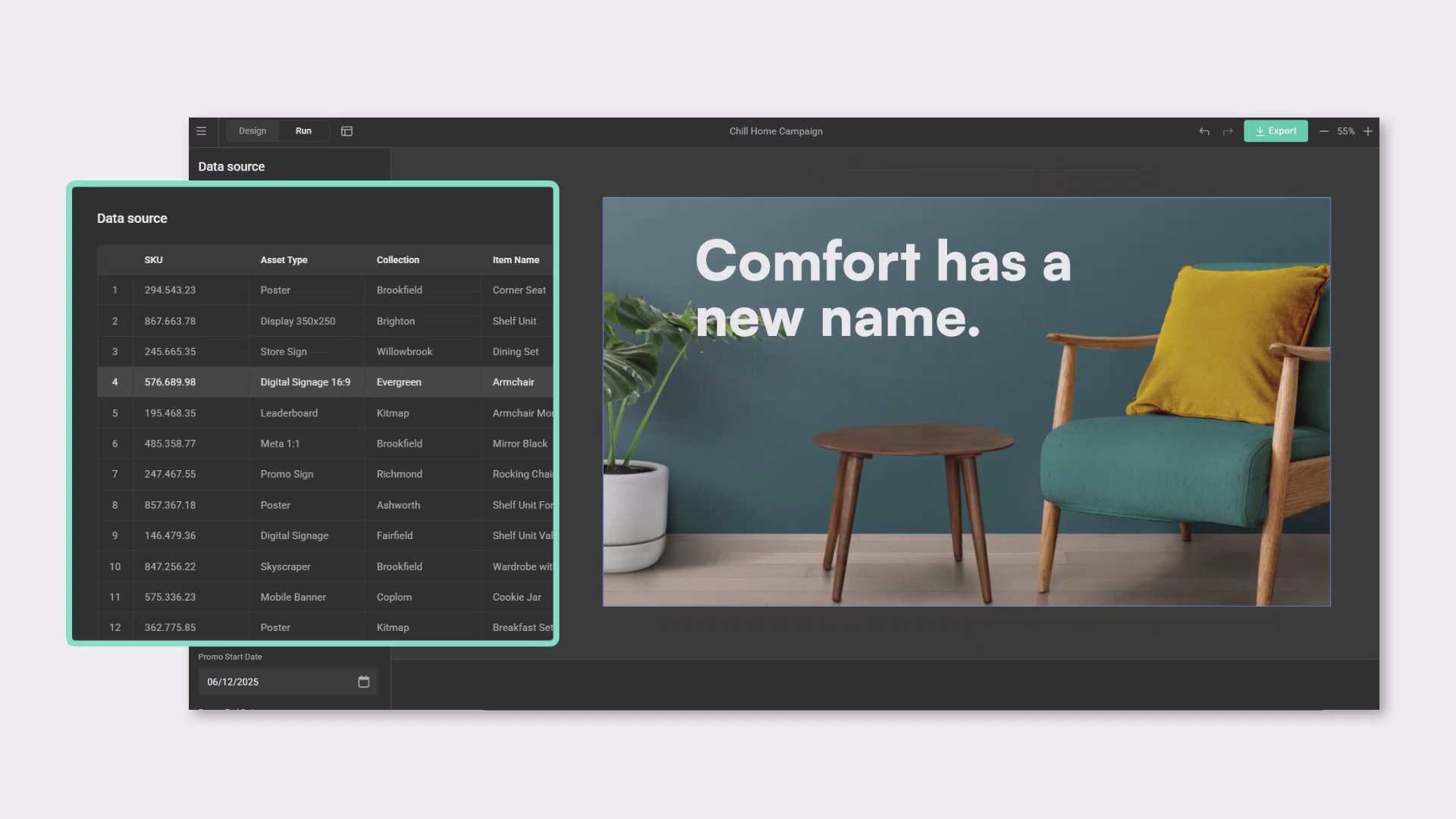
And because every channel draws from the same source, the brand stays consistent across all of them, rather than drifting as each tool applies its own interpretation.
That is efficiency and quality compounding together: the broader the scope, the more the savings stack, and the more reliably a campaign holds its brand from a printed shelf-edge label to an animated social ad.
The quality half: the cost of going off-brand
The cost of going off-brand is real, and our Brandwidth 2026 research puts a floor under how often it happens: 71% of retail marketing teams recently have had a promo production failure, and only 11% say their process reliably prevents the next one.

The exposure is not abstract. A failure surfaces as a promo that misprices a product, a campaign that misses its market window, a logo stretched out of spec on a poster nobody signed off. And it shows up on the efficiency line too, because when a deadline is at risk, 43% of teams absorb it through overtime or emergency agency support, paying a premium precisely to avoid going off-brand.
That is the quality cost and the efficiency cost arriving as one invoice. At the scale that The Coca-Cola Company, Jysk, Victorinox, Carrefour and Intermarché operate, brand consistency is the asset itself, and a governed design system builds the guardrails into the source, so non-designers can self-serve at volume and still produce work that is correct by construction.
Building your own case
That is the spirit of the paper. It does not claim a single ROI figure that fits every team, because no honest model could. It offers a way to reason about the question for your own organisation: the three efficiency pillars you can put numbers to today, the formulas and worked example behind them, and the Brandwidth research that frames what going off-brand actually exposes you to.
The quality half is harder to reduce to one number, but it is not unmeasurable, and it is the half that most often decides whether the investment was worth it.

Read The ROI of Creative Automation
Marketing

Kees Henniphof
Jul 3, 2026
Sign up for blog updates
Related articles


