
Introducing Brandwidth 2026: the state of promotional production in grocery retail
If you work in grocery retail marketing, you already know the campaign calendar does not move. A price error discovered at 4pm on a Thursday does not create a new deadline. It compresses the existing one.
What you may not know is how consistently that pressure produces the same outcomes across the industry, and what those outcomes are actually costing.
Brandwidth 2026 surveyed 256 marketing leaders directly involved in promotional production at grocery retail organizations across the United States, United Kingdom, France, Germany and the Netherlands.
The picture that emerges is one of significant operational complexity, managed largely through hybrid production models that place considerable pressure on central creative teams.
It is a cost to be managed.
Three in four grocery retail marketing teams cannot reliably handle a last-minute change.
The scale of normal operations
Before examining where promotional production breaks down, it is worth understanding the volume at which most grocery retail marketing teams are operating.

For a team producing 100 variants per campaign across five campaigns a month, that is 500 individual assets, every month, against promotional windows that cannot flex.
Most of those assets require adaptation across markets, languages and store formats. Many require regulatory compliance checks. All of them carry a brand integrity requirement that does not diminish under volume pressure.
This is not an exceptional workload. It is the baseline.

Grocery retail means high volumes, multiple markets, and deadlines fixed by the promotional calendar, not by the production team's capacity. CHILI GraFx moves that production risk from people to systems, so the deadline can be met without the team absorbing the cost every time.
Kevin Goeminne
CEO - CHILI publish
Where the promo production process breaks down
The research identifies three distinct fault lines in grocery retail promotional production. Each is significant independently. Together, they describe a system that is structurally unable to absorb the demands placed on it.
Speed: the approval problem
When asked to identify the single biggest constraint on moving a promotion from approved brief to live execution across all markets, two factors emerged effectively tied at the top.
Approval and review cycles were named by 40% of respondents. Data and content availability, meaning late-arriving pricing, product information, or assets, was cited by 36%.
The primary bottlenecks in promotional production are not creative capacity or production tooling. They are the governance process designed to protect quality, and the upstream data flows that feed it.
Consistency: the local speed problem
Fifty-two percent of respondents say that central teams become bottlenecks that local markets work around. Forty percent say that local teams bypass the official process entirely and create their own materials. Fifty-five percent say that brand guidelines are inconsistently applied across markets and stores.
One respondent at a global brand organization in an active evaluation conversation described the dynamic directly: "People have become so emboldened at the location or field level that they are now using AI. We've got to get a hold of this because it's just getting ridiculous."
The sequence is predictable. Central teams slow down under volume pressure. Local markets begin working around them to meet deadlines. Brand consistency deteriorates as a result. The governance structure designed to protect the brand becomes the reason it is inconsistently represented.
Error exposure: the reliability gap
The most significant finding in Brandwidth 2026 concerns not what occasionally goes wrong, but what reliably goes right.

Only 11% said their current process reliably prevents the next one.
Nine in ten grocery retail marketing teams, by their own assessment, are operating a production process that cannot reliably prevent the next failure. The teams who have already experienced one are not, in the main, teams that have fixed the underlying cause. They are teams that have absorbed the consequences and continued.

Fifteen percent miss the promotional window entirely. Twelve percent allow the campaign to go out with the error or outdated information.
At a creative production agency with an active retail client brief, a senior contact described what the current model requires of the teams executing it: "We receive so many tickets for creating one-pagers or ads. For such simple use cases, the time to create the briefing is much more than the time to create the actual asset."
What failure actually costs
The operational disruption is visible. The commercial cost is not, and Brandwidth 2026 makes a case that the two are not equivalent.

For grocery retail, where promotional pricing drives footfall, basket size and competitive positioning, a missed window is a direct revenue event. The revenue it was designed to generate does not carry over. It disappears.
Thirty-three percent report that promo production failures create legal or regulatory exposure from incorrect pricing or non-compliant materials. A print error at scale, across thousands of store locations, requires recall, reprint and in some markets a formal correction process. Brandwidth 2026 found that more than half of significant cost events in the surveyed sample landed between €10,000 and €50,000, with more than a quarter running higher.

Thirty percent say promo production failures damage relationships with FMCG brand partners. The promotional slot is a commercial commitment: the retailer undertakes to deliver a campaign, at specified quality, across a specified footprint, within a specified window.
When promo production failures cause that commitment to be delivered late or incorrectly, the retailer is in breach of a commercial agreement. FMCG brands that experience repeated execution failures will redirect their promotional investment.

Why the status quo persists
The research does not describe teams that are unaware of the problem. It describes teams that have normalized their response to it.
The most common coping mechanism — overtime and emergency agency support — is both expensive and structurally reinforcing. It resolves the immediate deadline pressure without addressing the underlying cause. Each successful resolution makes the next escalation slightly more acceptable. The system becomes self-sustaining.
One contact at a brand organization completing a creative automation evaluation put it plainly when describing the case for change: "The advertisements are a huge pain. People are doing so much manual stuff. You just want to get rid of it."
Fifty-five percent of respondents characterize the financial risk in their current promotional production process as medium — occasional incidents with limited but real financial consequence. Nine percent describe it as high, with errors or delays regularly creating measurable cost or revenue impact. Only 26% characterize it as low.
Eleven percent have not formally assessed this risk at all.

That final figure is perhaps the most consequential in the report.
A production process that carries measurable financial exposure and that the organization has not formally assessed is not a low-risk process. It is an unmanaged one.

The automation gap
The research finds clear appetite for change. Forty-two percent of respondents anticipate that around half of their campaign design process will be automated within three years. A further 42% anticipate around a quarter.

The production failures documented throughout the report appear to have shaped a precise view of where technology would deliver the most immediate and tangible value.
The transition challenge is not primarily technological. The tools to automate data-driven variant production, connect source systems to creative workflows and enable local self-service within brand-governed parameters already exist and are in use by leading operators across the industry.

The transition challenge is organizational: workflow redesign, template investment, change management and the stakeholder alignment required to move from a people-dependent production model to a system-dependent one.
For teams that have normalized their current coping mechanisms, the perceived cost of transition can feel higher than the perceived cost of continuation.
The data in Brandwidth 2026 suggests that perception is incorrect.
The cost of continuation — measured in overtime, missed windows, error remediation, FMCG partner friction and brand inconsistency — is already substantial. It compounds with every campaign cycle, every peak season and every market added to the operational scope.
Our product vision for CHILI GraFx is on-brand by design, at retail speed. Those two things are not in tension; they are the point. When brand compliance is built into the system rather than enforced through approval chains, you stop trading speed against accuracy.
Ward De Langhe
Chief Product Officer - CHILI publish
Read the Brandwidth 2026 report
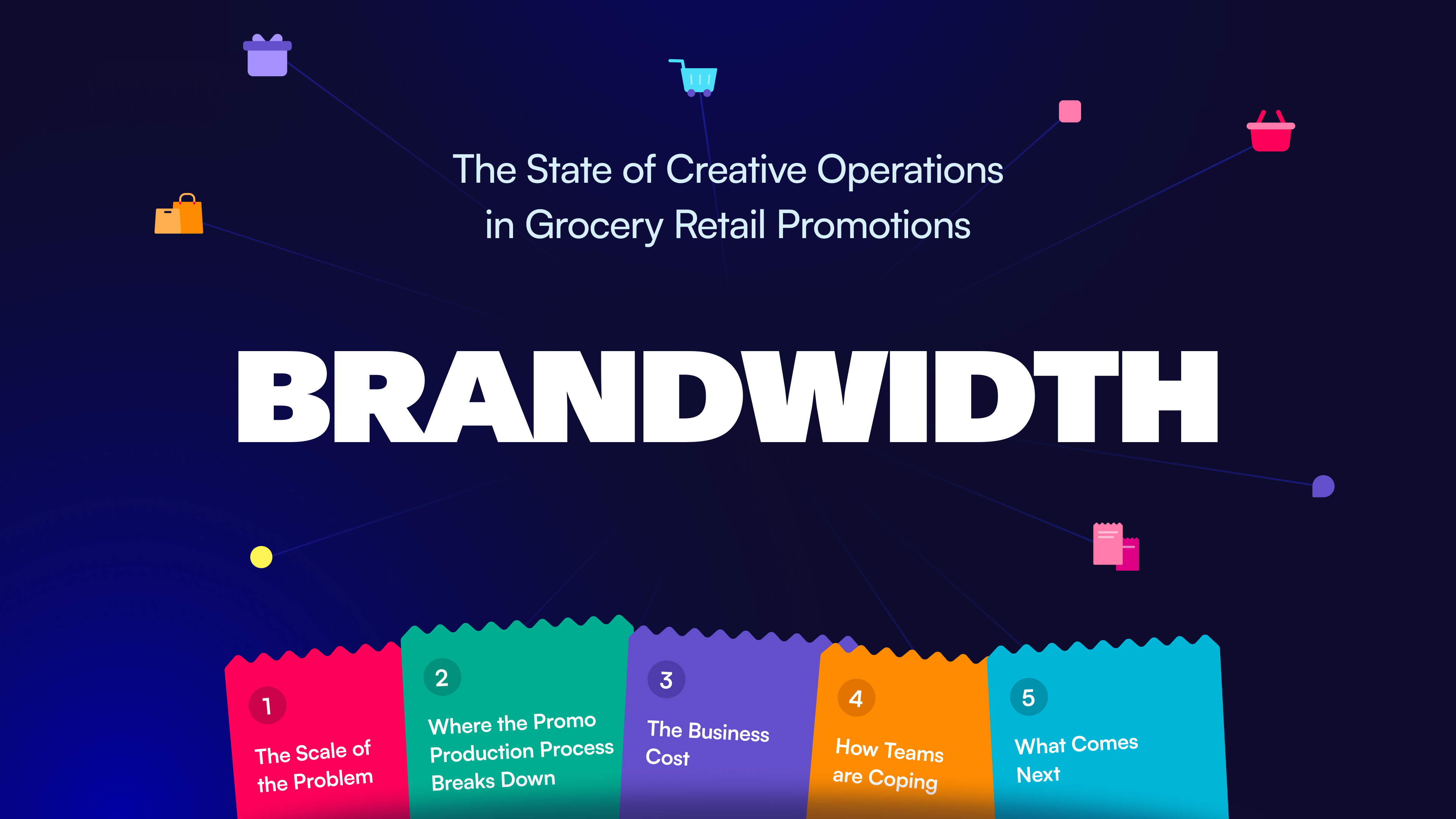
Brandwidth 2026 covers five sections in full: the scale of the problem, where the production process breaks down, the business cost of failure, how teams are coping today, and the automation outlook.
The complete report is available to download here.
Teams that want to benchmark their own risk exposure against the Brandwidth 2026 sample can use the Promo Execution Risk Calculator — free, anonymous and takes approximately three minutes from start to risk assessment. It profiles your current process across three exposure dimensions: revenue, brand and regulatory.
Brandwidth,
Marketing

Kees Henniphof
Jun 2, 2026
Sign up for blog updates
Related articles


