
Victorinox: Engineering Brand Consistency at the Speed of Local Markets
For a company that has manufactured its iconic Swiss Army knife from the same Swiss town since 1884, Victorinox has never confused tradition with complacency. CEO Carl Elsener Jr. has made the company’s strategic philosophy explicit: “We think in generations, not in quarters.” That long-term lens now extends to marketing operations — and to a fundamental rethink of how a premium global brand equips local teams and retail partners to produce and distribute marketing communications, promotions, and point-of-sale materials without sacrificing the Swiss precision the brand stands for.
The Opportunity: A Global Brand, Thousands of Local Executions
Victorinox operates across more than 120 countries, generating CHF 426 million in annual sales and US$68 million in e-commerce revenue in 2025 alone.

CMO Veronika Elsener has defined the challenge in terms of principle: “We built a brand campaign which allowed our markets to execute with flexibility based on their own needs.” The question is how you operationalize that at scale — how you give local teams and retail partners genuine creative freedom within a framework that keeps the brand intact.
Until now, the answer was largely manual effort. Creative production teams handled repetitive adaptation work — resizing, reformatting, adjusting for local markets — that consumed capacity better spent on strategic output.
The company’s broader digital transformation made the alternative increasingly visible. A Salesforce rollout across Sales, Marketing, Commerce, and Service Clouds (2024–2025) automated 80–90% of customer data entry, saving the sales team approximately one full working day per week. A paperless QR code workflow delivered a 40% efficiency improvement in watch repair services. The logic was clear and consistent: automate the repeatable, free the team for the work that compounds.
Creative production was the next domain to address.
The Vision: Seen Clearly, From the Start
When Victorinox first engaged with CHILI publish in early 2025, the practitioners closest to the production challenge understood the potential immediately.
Violeta Jaksic, Service Owner Content Platforms at Victorinox headquarters in Ibach, Switzerland, had direct ownership of the company’s DAM platform (Bynder), its CMS, and the creative tooling that supports marketing execution across the business.

The CHILI GraFx proof of concept, built in April 2025 directly from Victorinox’s own InDesign source files and brand guidelines, made the case visually and immediately. The demo covered AI-powered smart cropping across product categories — Swiss knives, watches, cutlery — multi-format output from a single design system, simulated Bynder DAM integration, and category-based template access control for different user types.
The internal stakeholders who saw it for the first time had an unambiguous response. As Jaksic reported back: “What they saw from the first sight, they said: this is the solution.”
By September 2025, a working MVP — built to Victorinox’s actual brand guidelines, covering A4, A3, and A5 formats with partner logo fields, QR code support, print-ready PDF export, and a live connector to their Bynder DAM — was in the team’s hands for live testing.
The platform’s interim Transformation & Technology consultant, brought in to assess marketing processes and tooling across the business, confirmed the strategic fit: “The appetite is quite enormous in the company. There are lots of potential improvement projects throughout marketing.”

The Platform: Brand at the Center, Execution at the Edge
What Victorinox is deploying is not a design tool. It is a production infrastructure — one that shifts the role of the central creative team from execution to governance.
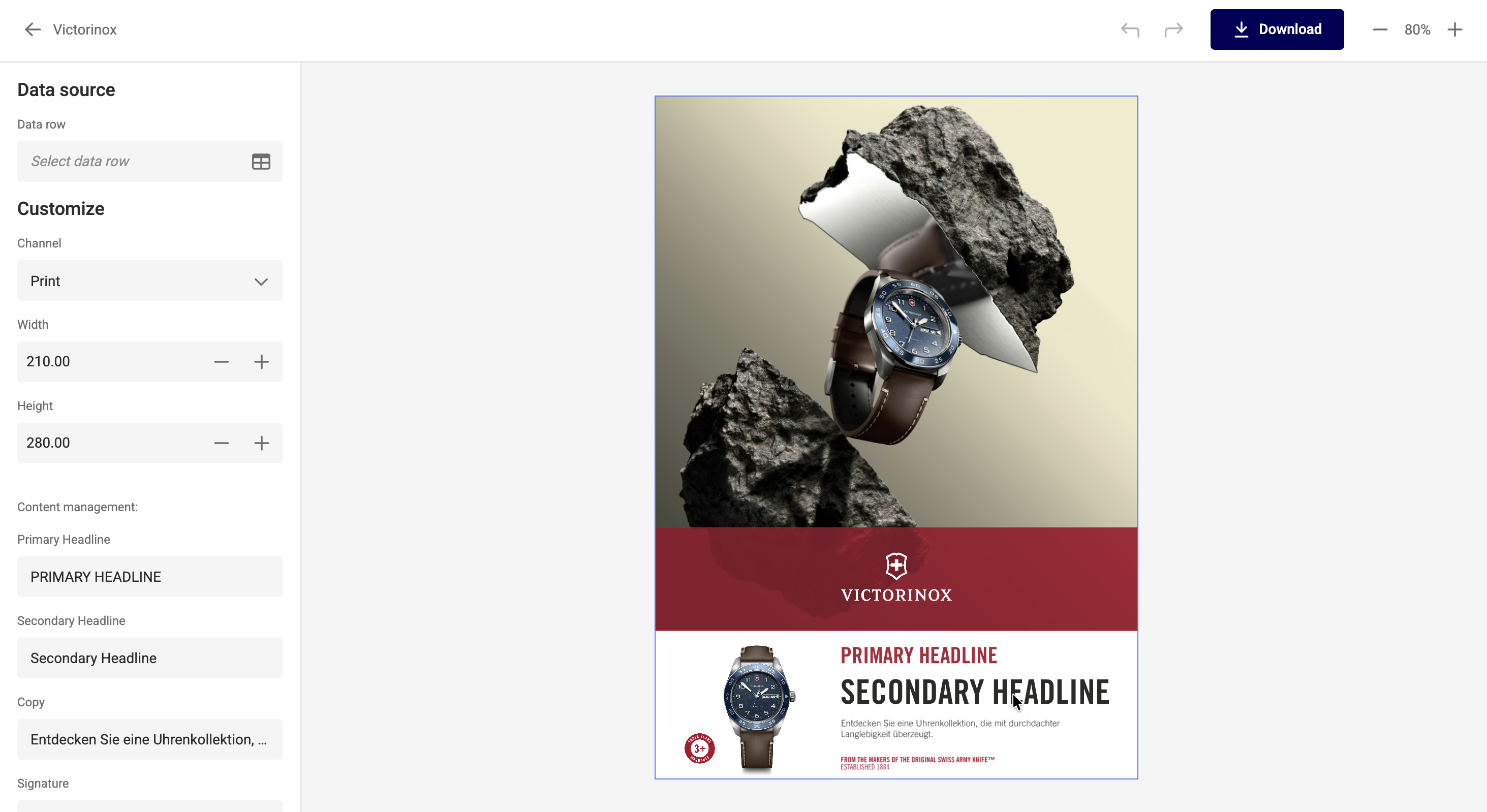
GraFx Studio allows Victorinox’s designers to build intelligent design systems from existing InDesign templates. Those systems encode the brand: typography, color, layout logic, image behavior, copy rules. What gets exposed to local marketing teams, retail partners, and approved external collaborators through GraFx Experience is a controlled creative environment — one where users make permitted adaptations without touching the underlying brand architecture.

The technical requirements Victorinox specified reflect the scope of this deployment: user group management, single sign-on, API integration with Bynder, and custom portal configuration for external access. Approved freelance designers, photographers, and retail partners will operate within the same system as internal teams — with access rights calibrated to their role.
The Head of Global Procurement, who led commercial negotiations, articulated the decision in terms that reflect how Victorinox approaches every significant technology investment: “We are looking for a long-term partner. We are not looking for something short.”
What Changes
Victorinox enters implementation with a focused initial scope: advertising templates across product categories, integrated with Bynder, with controlled access for internal and external users.
The transformation ahead is practical and specific. Local market teams will produce brand-compliant promotional and POS materials without routing every adaptation through a central design resource. Retail partners will access category-specific templates configured for their product range. Brand governance will shift from manual review and correction to systematic enforcement at the template level.

For a brand built on Swiss precision — one that thinks in generations — the goal is to make that precision the default, not the exception, at every marketing touchpoint across 120 markets.

Company profile
Victorinox is a globally renowned Swiss manufacturer best known for creating the iconic Swiss Army Knife. Founded in 1884, the fourth-generation family-owned company remains headquartered in Ibach, Switzerland, and has expanded its product offerings to include cutlery, watches, travel gear, and fragrances.