

The Price Tag Is a Brand Asset. Start Treating It Like One.
In 1861, a Philadelphia merchant named John Wanamaker did something that his peers thought was commercially insane. He attached fixed price tags to every item in his store. No negotiation. No haggling. One price, visible to everyone.
Fellow retailers criticized him. But Wanamaker's point was never just about fairness. It was about brand. A visible, consistent price communicated something about who you were as a retailer: transparent, modern, trustworthy. The price tag was, from its first moment, a brand statement.
That insight never changed. What changed is how many price tags retailers have to manage — and how catastrophically hard it has become to keep them consistent.
Pricing Has Always Been Brand Communication
The assumption that separates good retailers from great ones is this: the way a price looks is not an operational decision. It is a brand decision.
Research into the history of retail pricing design makes this impossible to dispute.


This is not a soft insight. It is backed by data that retail brand managers should have in front of them: 85% of customers cite color as the primary influencer in their purchase decision.
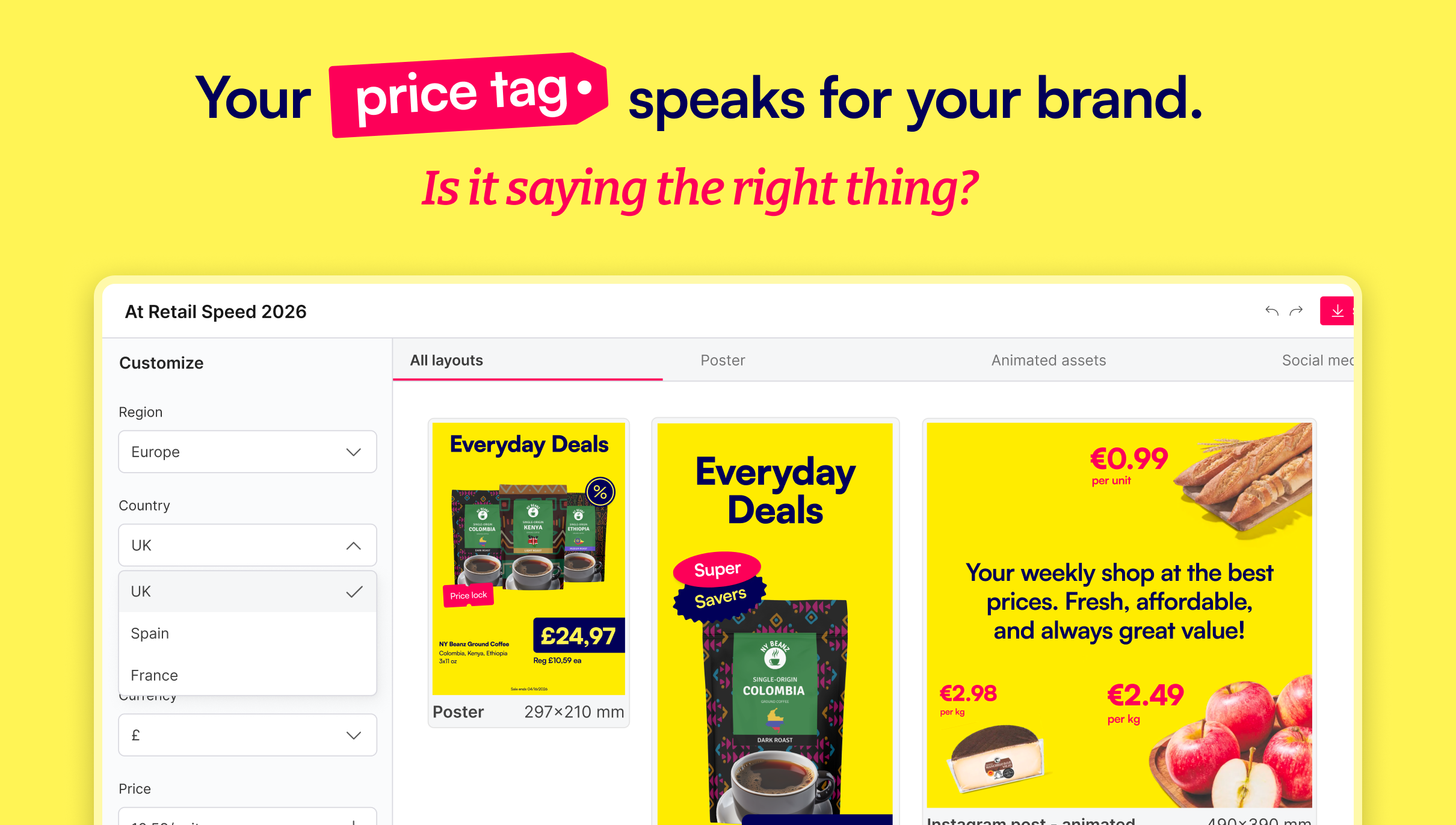
A Gartner survey of consumers found that 80% equate consistent pricing with brand trustworthiness, and 68% report that dynamic pricing makes them feel taken advantage of. The way a price is displayed is a trust mechanism. Inconsistency erodes it.
The Scale Problem That Makes Consistency Almost Impossible
Understanding that pricing is brand communication is the easy part. Actually executing it consistently is where retail organizations break down — and have broken down for decades.
Consider a single sofa that IKEA sells across five markets: Germany, Austria, the United States, Japan, and Turkey.

Each of these differences is not a translation problem. It is a design problem. And IKEA has 12,000 products, 63 markets, and 30-plus languages.
Scale this to weekly promotional circulars — still the dominant pricing communication vehicle in grocery retail — and the numbers become almost absurd. Large chains produce millions of bespoke in-store communication materials every year. Lenta, one Russian grocery chain, produces more than one million bespoke communication posters annually just to meet in-store promotional requirements. Each one must correctly represent a price, in the right currency format, at the right hierarchy, with the right color coding, in brand-compliant templates, to tight weekly deadlines.
That is a genuine improvement. But it has always had a structural limitation.
The automation model works as long as the design elements inside those design systems are correct, current, and consistent. When the brand changes the color code for a promotional price badge, someone has to update every template. When a new promotion mechanic is introduced — "lowest price guarantee" rather than "two for one" — every template carrying a pricing block needs to be reopened and rebuilt.
The automation handles data throughput. The design governance is still manual.
What Components in GraFx Studio Actually Change
Components in GraFx Studio address this at the structural level, not the workflow level.
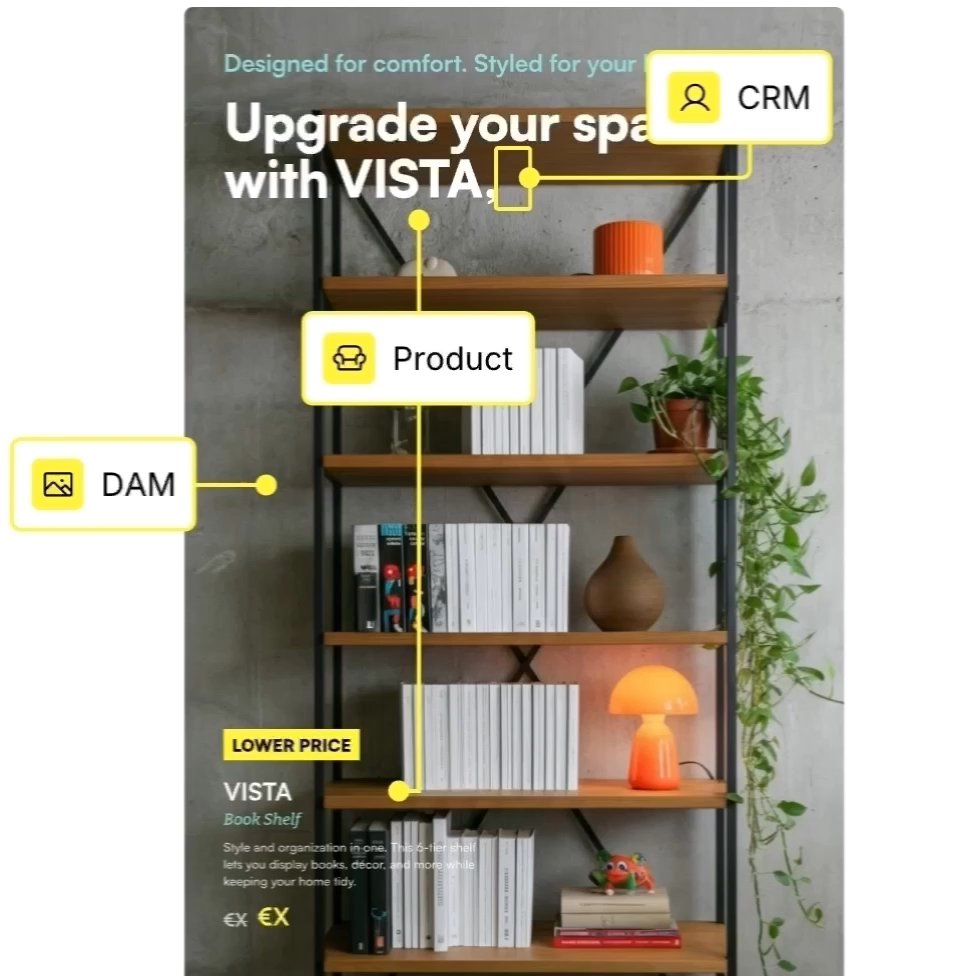
A Component is a reusable design element — a pricing badge, a product ad layout, a promotional label — that you build once and place into any template. The critical difference from a smart template is what happens when the design changes. When you update a Component and save it, every template that references it reflects that change automatically. No reopening files. No find-and-replace across a template library. One edit, everywhere updated at once.

This matters for retail pricing communication specifically because the pricing element is the design object most likely to need updating, most likely to appear across dozens of templates, and most likely to be damaged by inconsistency.
The use case is as direct as it gets: a grocery retailer running weekly promotions with coupon sheets. Each coupon shows a product image, a product name, and a price — with the price element varying by promotion type: reduced price, two for one, lowest price guarantee.
In a traditional template model, the pricing logic for each promo type exists independently in every coupon on every template. When the brand updates the visual treatment — or adds a fourth promotion mechanic — every template needs manual attention.
With Components: the pricing element is designed once, with all promotion type logic built in. The Component is placed once per coupon on the sheet. Each instance is mapped independently to that coupon's own price and promotion variables. When the brand updates the look or adds a new mechanic, only the Component changes. Every template using it reflects the update automatically — without field teams or store owners needing to do anything.
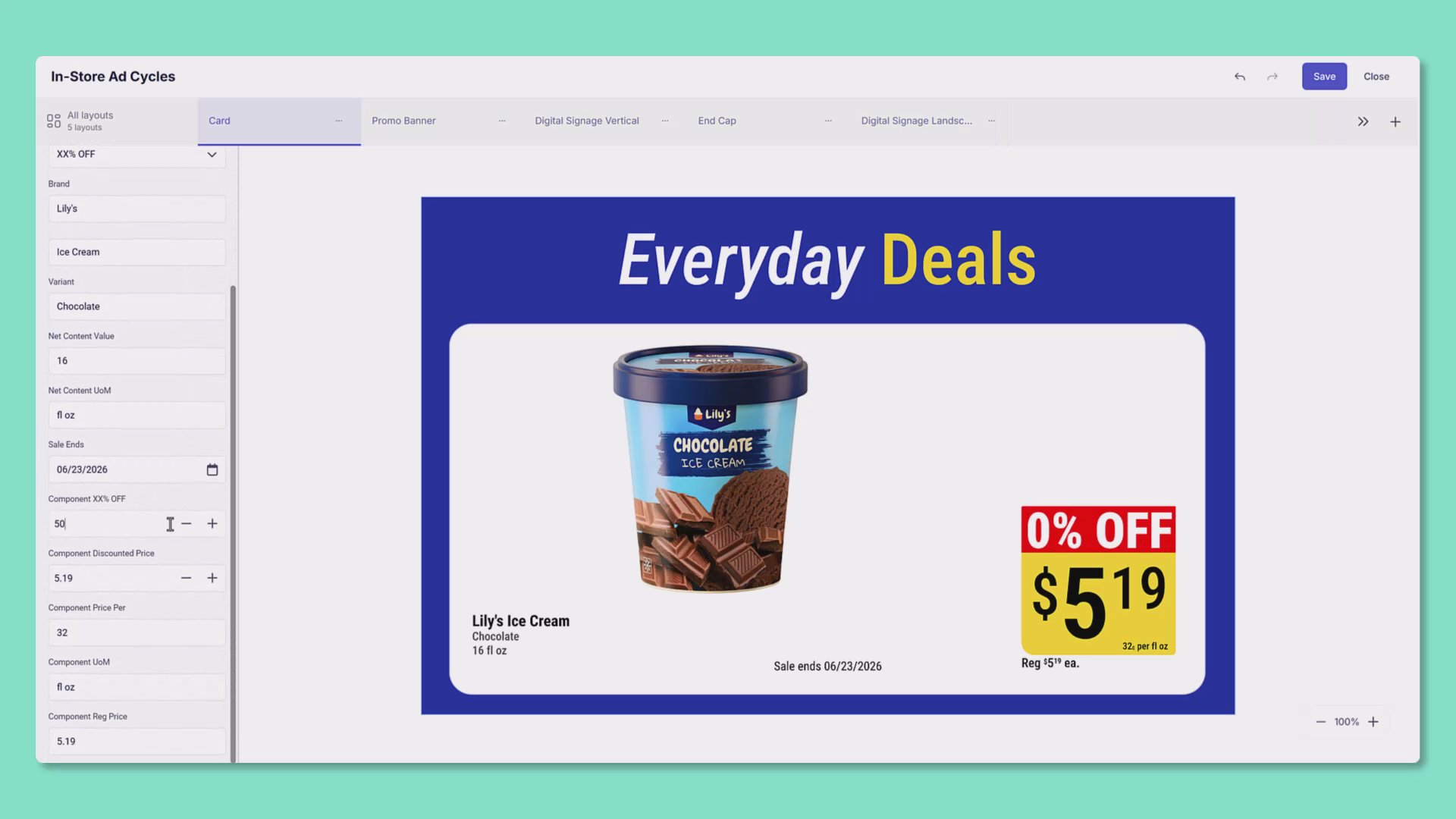
The governance implication is equally significant. A Component's internal design cannot be edited from the template. Local teams see only the variables exposed to them. They can fill in the price. They cannot touch the color, the typography, the badge shape, or the business logic. The Carrefour principle — pricing modules as brand assets with codified rules — is no longer dependent on training, guidelines, or approval chains. It is enforced by the system itself.

The Discipline That Retail Has Always Known It Needed
What the history of retail pricing design shows, from Wanamaker's first price tag to Jumbo's custom numerals to Carrefour's communication codification, is that the best retailers have always understood pricing as a designed discipline. What has changed is the technical infrastructure to enforce it at scale.
The Jumbo case is worth sitting with for a moment. When Studio Eyal and Myrthe redesigned Jumbo's visual identity in 2017, they designed not just a new logo and a custom typeface but a specific numeral variant of that typeface for price stickers — maximally legible at small sizes, visually consistent with the broader brand identity, built specifically for the shelf format. That is the level of design investment that a serious retail brand makes in pricing communication.
Most retail organizations cannot justify a custom typeface project. What they can do is ensure that whatever visual system they have built for pricing communication is governed structurally — not through guidelines that local teams may forget and approval processes that slow down peak-season execution.
That is precisely the problem Components is built to solve. Not faster production, though it enables that. Not better-looking templates, though it enables that too. The core promise is simpler: design it right once, and let the system keep it right everywhere.
Given that 80% of consumers equate consistent pricing with brand trustworthiness, that is not a minor capability. It is a structural response to one of the most consequential brand problems in retail.

Marketing

Kees Henniphof
May 8, 2026
Sign up for blog updates
Related articles


