
Discover the newest and latest updates. All-new product features and improvements are right here.
CHILI GraFx Environment API: Take Control of Headers in GraFx Connector Proxy Requests
Some external systems hand back pre-signed URLs – CDN links that carry their own authentication in the query string. When the CHILI GraFx proxy forwards your GraFx Connector's Authorization header to one of those URLs, the upstream rejects the request and the asset fails to load. It's a subtle conflict between two valid authentication mechanisms, and until now there was no clean way to resolve it.
The CHILI GraFx Environment API now gives you that control.
Exclude Specific Headers on a Per-Request Basis
A new request header – X-GraFx-Proxy-Exclude-Headers – lets you tell the proxy exactly which headers to drop before the outbound request reaches the external system. Provide a comma-separated list of header names, and those headers are removed. Header names are matched case-insensitively, surrounding whitespace is trimmed, and X-GraFx-Proxy-Exclude-Headers itself is never forwarded.
For example, to prevent the connector's Authorization header from reaching a pre-signed CDN URL:
X-GraFx-Proxy-Exclude-Headers: Authorization
This works on both GET and POST connector proxy requests.
Practical Impact
This update directly fixes a reliability issue for GraFx Connectors that serve assets through time-limited signed URLs – including the Aprimo connector. Those connectors can now work without the proxy interfering with the upstream's own authentication mechanism.
For teams building headless production workflows on CHILI GraFx, this is a targeted fix that removes an edge-case failure point without requiring any changes to existing connector configuration.
GraFx Studio: Smarter Smart Crop, Combined Text Sizing, and More
AI-powered image cropping is only as good as its predictability. When a designer can't trust that the subject will land where it should across every aspect ratio, they end up babysitting automation instead of benefiting from it. This GraFx Studio release addresses that directly – with a major upgrade to Smart Crop and a set of improvements that make building design systems faster and more reliable.
A Smarter Smart Crop
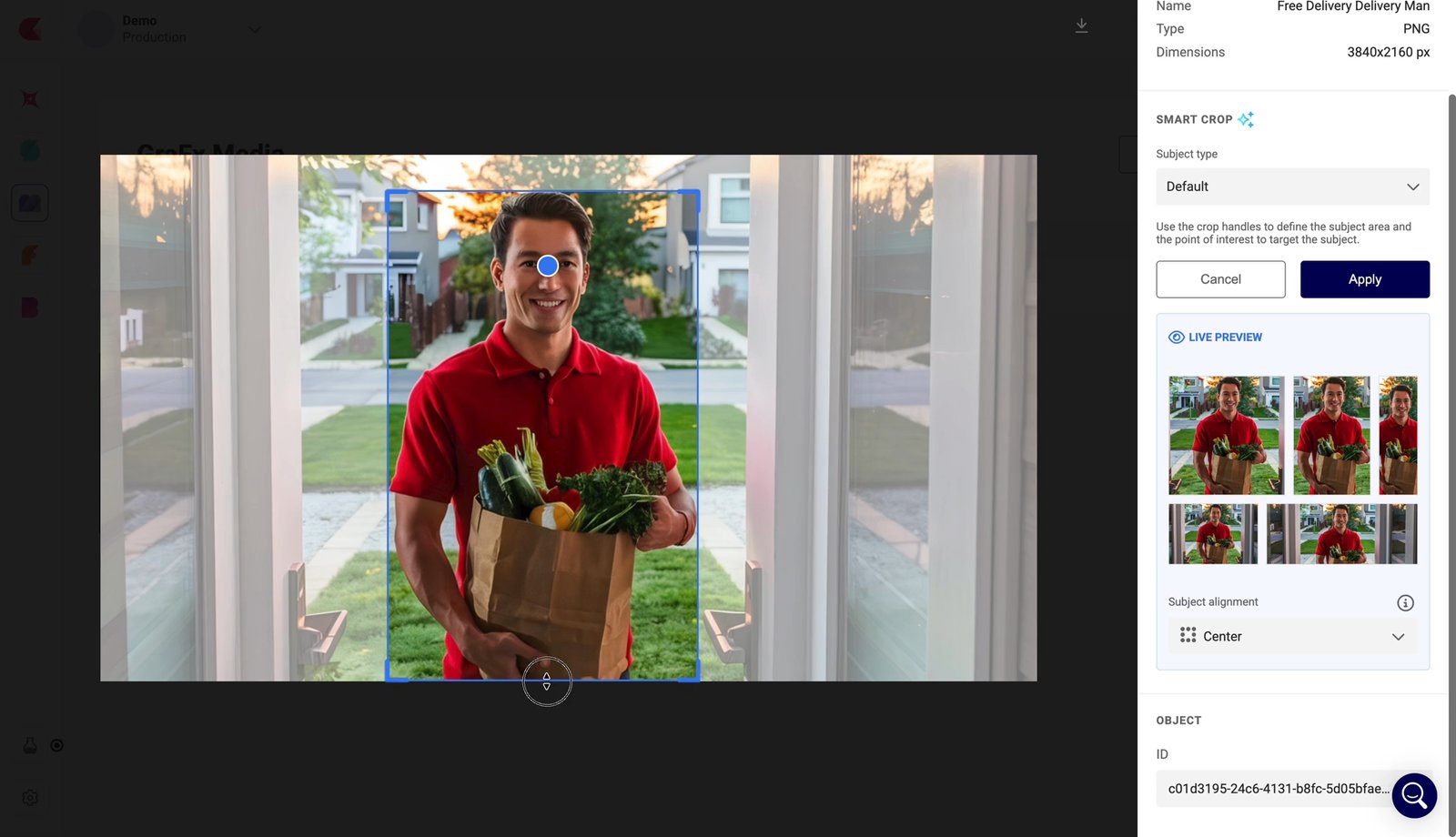
Smart Crop is GraFx Studio's AI-driven fill mode, powered by GraFx Genie, that automatically positions an image inside a frame so the most important part stays visible. This release is a significant step forward.
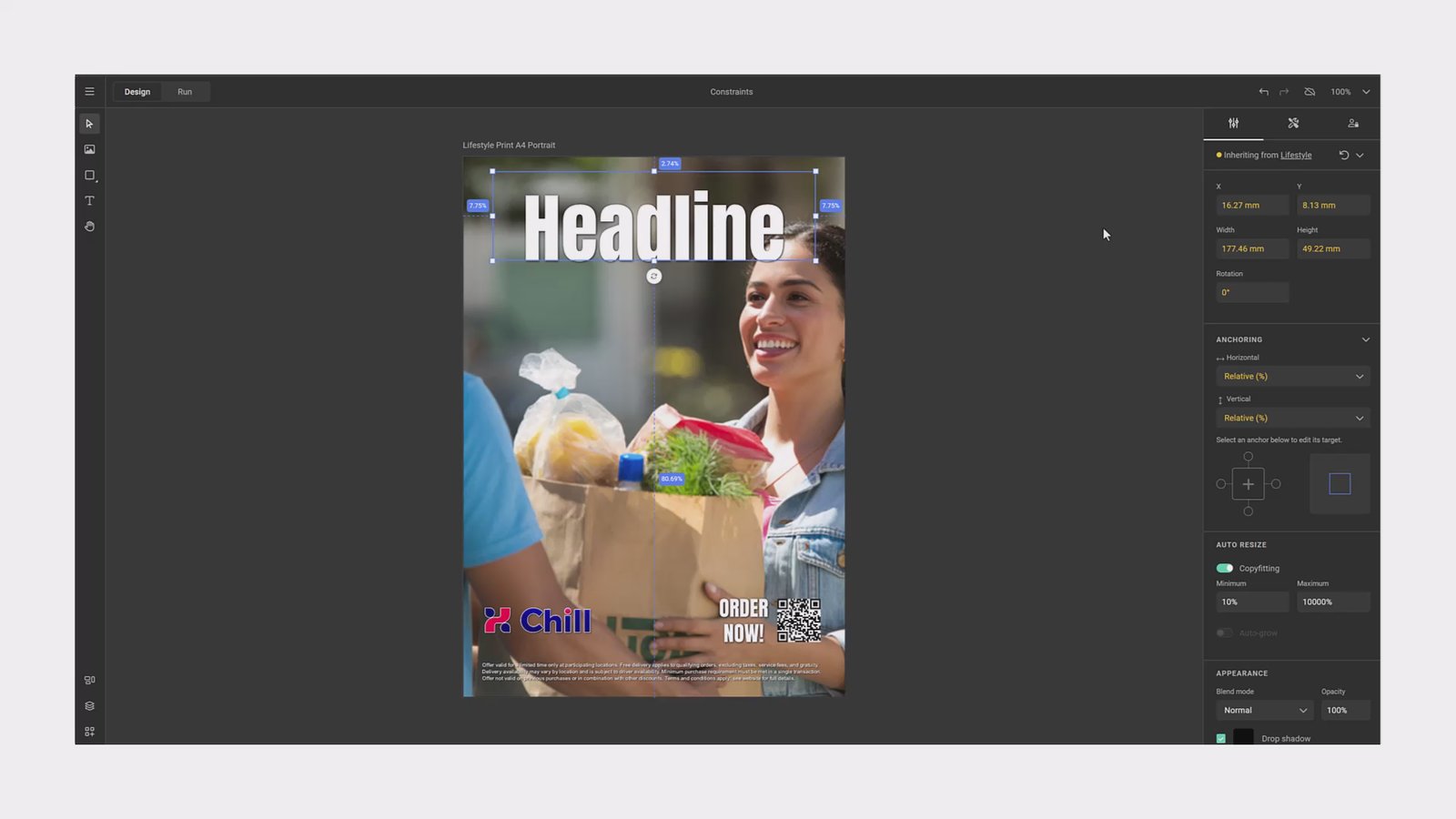
The updated algorithm is built around clear priorities: the frame is always filled completely, the Point of Interest always stays inside the Subject Position, and as much of the Subject Area as possible is preserved – cropping only as a last resort. Less trial-and-error, more consistent results.
Four additional improvements come with this upgrade:
Subject alignment: Nudge the subject toward any side of the Subject Position instead of always centering it – useful when a subject needs to sit against a layout edge across different aspect ratios.
Automatic versioning: Each frame keeps the Smart Crop version it was built with, so existing designs render exactly as before. A "New smart crop available – apply it" prompt lets you upgrade any frame to the latest algorithm in one click.
Five live previews: The asset details panel now shows five preview aspect ratios instead of three, in both GraFx Media and the GraFx Studio workspace, making it easier to validate Subject Area and POI settings before committing.
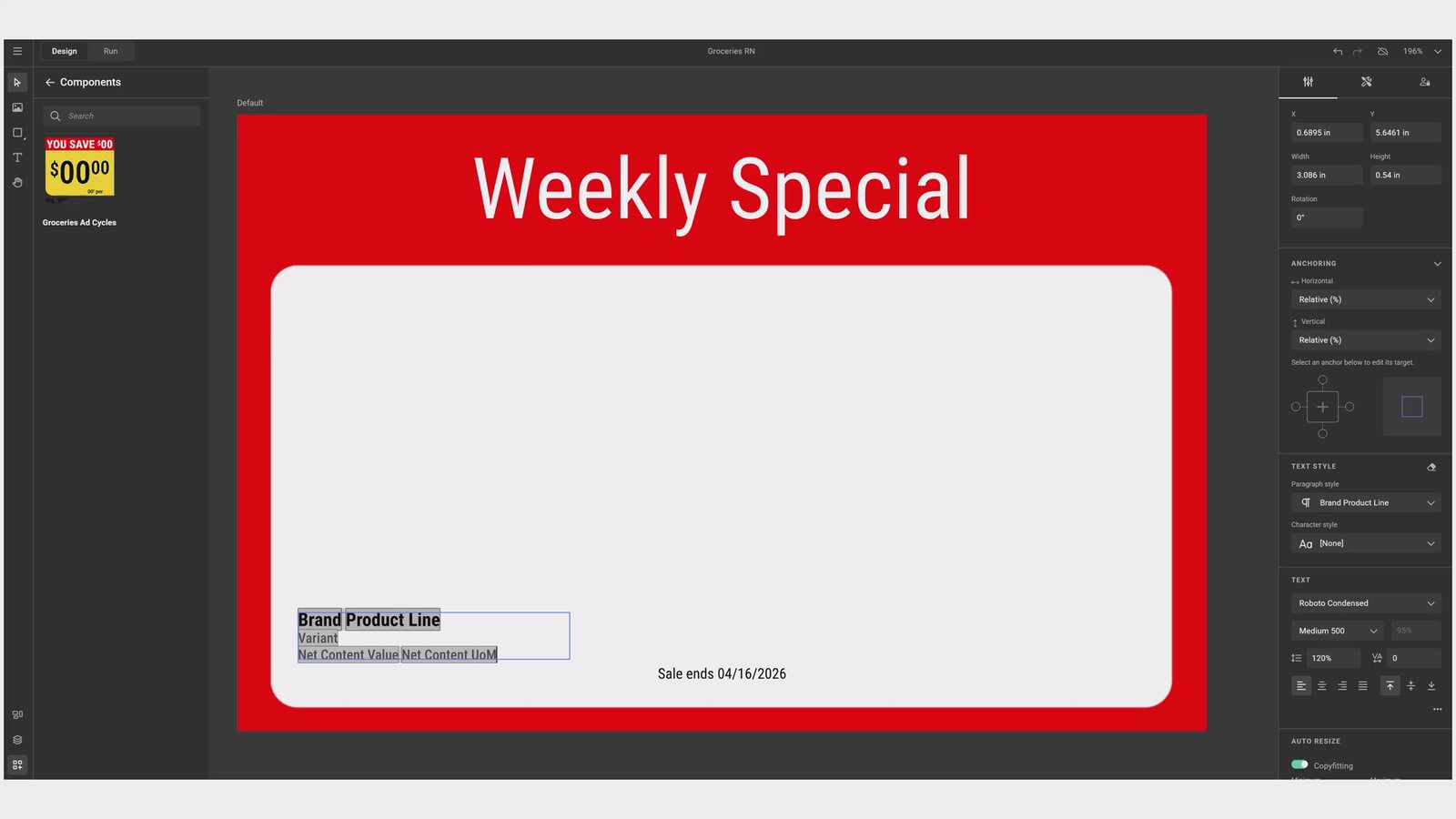
Text frames can now use auto-grow and copyfitting at the same time. A frame can expand to fit its content while copyfitting keeps the text within defined size limits – a combination that previously required choosing one behavior or the other. For data-driven layouts with variable text lengths, this removes a real design compromise.
More Improvements in This Release
Component image variables mapped to list variables: Template Designers can now map a component's image variable to a single-select list variable, giving more flexibility in how component imagery is driven from list-based choices.
Richer metadata mappings: Metadata mappings now support additional variable types, so more asset metadata can flow into layouts automatically.
Layouts & Pages tabs always visible: The Layouts and Pages tabs now stay visible for every layout intent – including animation and digital static – keeping navigation consistent regardless of what you're designing.
Reorganized gradient color picker: The Colors/Custom toggle now sits below the gradient bar for a cleaner, easier-to-read interface.
Clearer missing font warning: When you add a component containing a missing font, GraFx Studio now shows an error dialog immediately instead of failing silently.
GraFx Connector improvements: Unused GraFx Connectors are automatically removed from a document on save, and connector mapping now offers expanded options for how a data source maps into your layouts.
Bug Fixes
This release also resolves several issues across the workspace: the Layouts panel no longer jumps to the top when selecting a layout; the override dropdown is correctly sized again; the interface refreshes properly when undoing a variable switch; a template keeps its correct name after "Save as"; and the character-limit field accepts its maximum value again.
On the text rendering side, three issues are fixed: incorrect letter tracking when combined with a stroke, a misplaced glyph for a specific font, and a separate font that rendered incorrectly.
For images and frames: canvas images now update immediately after a GraFx Brand Kits sync, and copying and pasting an anchored frame onto a different page works correctly.
For reliability: all requests now go through the authentication refresh mechanism – reducing unexpected failures during long sessions – and the SDK's image-upload staging call handles token expiration correctly.
Check out GraFx Studio to explore everything in this release.
CHILI GraFx Environment API: Font Previews Now Display Correctly for Newly Uploaded Fonts
A font preview is the sample image CHILI GraFx generates for each font style – a quick visual reference so you can identify a typeface at a glance without opening a design. When those previews render incorrectly, choosing the right font becomes a guessing game.
This fix puts that right.
Square Font Previews Now Wrap Correctly
The 400×400 square preview generated for newly uploaded fonts was rendering its sample text on a single line, leaving most of the preview area empty instead of showing a properly wrapped, readable sample. Newly uploaded fonts now generate a correctly wrapped square preview – showing the typeface as intended.
No configuration changes are needed. The corrected behavior applies automatically to fonts uploaded going forward.
For teams managing large font libraries through GraFx Fonts, accurate previews are a small but meaningful part of keeping designers moving quickly – the right typeface, confirmed at a glance.
CHILI GraFx Platform: Faster Integration Testing, Smarter Asset Management, and Cleaner Connector Visibility
A handful of well-placed improvements can quietly remove a lot of daily friction. This CHILI GraFx platform update does exactly that – across integration setup, asset management in GraFx Brand Kits, GraFx Studio library navigation, and GraFx Connector configuration.
Generate an API Token in One Click
Testing an integration against the GraFx APIs used to mean running through the full OAuth flow just to get a token. That step is gone. You can now generate a token directly from the integration settings panel – right next to the client secret – and copy it to the clipboard in a single click. A toast confirms the copy. No extra tooling required.
Sort Templates and Elements by Date in GraFx Studio
The Templates and Components pages in GraFx Studio now support two additional sort options: Date created and Last modified. Both appear as columns in the list view, with times displayed in UTC for consistency. In larger libraries, this makes it straightforward to surface recently updated designs without scrolling through everything else.
Clearer Visibility for GraFx Connector CLI Installs
GraFx Connectors deployed via Connector CLI are now shown in a disabled state on the environment's Connectors page. The availability toggle is visible but no edit actions are available – hovering over the row shows a tooltip explaining that editing must happen through Connector CLI. The Add Connector button now goes directly to the Connector Hub flow, without an intermediate modal.
Separate Authentication for Single-Auth GraFx Connectors
GraFx Connectors that expose only one authentication method can now have separate authentication configuration for server-side and browser-side use. This is particularly useful for token injection scenarios – for example, setting browser authentication to [None] while the server uses a configured auth method. Previously, this flexibility was only available for GraFx Connectors supporting multiple auth methods.
More Control Over Assets in GraFx Brand Kits
Two improvements make Brand Kit asset management more flexible:
Broken references: If a media asset used in a Brand Kit has since been deleted from GraFx Media, the Brand Kit now shows a clear "Image not available" placeholder with Replace image and Delete image actions to resolve it.
Universal replace: The Replace image action is now available for all assets in a Brand Kit – not just deleted ones – so you can swap out any image without removing and re-adding it.
Bug Fixes
Pressing Enter in description input fields (such as integration descriptions or GraFx Connector JWT private key fields) now correctly adds a new paragraph in all cases.
The storage indicator on the CHILI GraFx homepage now correctly reflects used and total storage across all subscription configurations.
CHILI GraFx Environment API: Clearer Swagger Examples and Faster Responses
Good API documentation and fast response times are not optional extras – they are the foundation that integrations are built on. The latest CHILI GraFx Environment API update delivers on both.
Swagger Examples That Reflect Reality
The Swagger examples for the Media and Template GET endpoints have been refreshed to accurately reflect what the API returns today. When the examples in your interactive documentation match actual responses, building and debugging integrations becomes significantly faster – no more cross-referencing what the docs say with what the API actually returns.
You can access your environment's Swagger documentation directly from your integration setup. See Making API Calls for details.
Faster Responses on the Operations You Use Most
The most heavily used Environment API operations now respond faster, thanks to more efficient cache communication. No changes are needed on your side – the improvement is automatic.
For teams running high-volume, data-driven content production on CHILI GraFx, faster API responses compound quickly across automated workflows.
Adobe® Photoshop® Clipping Masks Now Export to GraFx Studio
Moving a Photoshop® document into another system rarely goes without a hitch. Shaped images lose their masks, arrive as plain rectangles, and need to be rebuilt by hand. With v1.4.0 of the GraFx Studio Exporter for Adobe® Photoshop®, that rebuild step is gone.
Clipping masks – one of the most common image shaping techniques in Photoshop® – are now preserved when you export to GraFx Studio.
Clipping Masks That Arrive Intact
The exporter translates Photoshop® clipping setups into Studio-native clipping masks, covering two scenarios:
Built-in shapes: Images clipped with a Rectangle, Ellipse, or Polygon export as Studio clipping shapes, with corner and stroke properties preserved.
Custom paths: Images clipped with a custom path are converted to a path-based clipping mask in GraFx Studio.
Stroke color, stroke width, and corner properties all carry through. Nothing needs to be reconfigured after export.
A Note on Preflight Warnings
The exporter shows a preflight warning for every document that contains at least one clipping mask. This is a precaution: in Photoshop®, a clipping mask can extend beyond the image it clips and display an overflow fill – something GraFx Studio handles differently. If your masks stay within their frames, the warning can safely be ignored.
Merged shapes, combined shapes, masks applied to layer groups, and complex paths are not yet supported and will be flagged in preflight.
For teams converting Photoshop® layouts into scalable GraFx Studio design systems, this update removes a meaningful manual step. The visual structure you built in Photoshop® arrives ready to use.
TIFF Images Now Supported in Print Output via GraFx Media
Print production has always demanded color accuracy above everything else. When a CMYK image loses its color space somewhere between the asset library and the final PDF, the consequences show up on press – and fixing them costs time, money, and trust. GraFx Media now closes that gap for TIFF assets.
TIFF images stored in GraFx Media can now be used in your designs and will come through correctly in PDF output generated by GraFx Studio.
Full Resolution, Original Color Space – All the Way to Print
When GraFx Studio generates a PDF for print, TIFF assets are now served at full resolution with their original color space intact. A CMYK TIFF stays CMYK from GraFx Media through to the final PDF. No color space conversion, no quality loss, no surprises at the print stage.
This matters most for teams producing print-ready output at scale – packaging, catalogues, direct mail, point-of-sale materials – where color fidelity is a hard requirement, not a preference.
TIFF Joins the Full Print Format Lineup
TIFF now works alongside JPG, PNG, and PDF as a supported format for high-resolution print output in GraFx Media. For production teams whose asset libraries are built around TIFF files – a common standard in professional photography and prepress workflows – this removes a real barrier.
Previously, using a TIFF asset meant converting it to another format before it could be placed in a design destined for print. That extra step added friction to the workflow and introduced the risk of color profile changes during conversion. Now, TIFF assets can go straight from GraFx Media into a print-ready PDF without any intermediate processing.
What This Means in Practice
For designers and production teams working inside CHILI GraFx:
TIFF assets already stored in GraFx Media are ready to use in print layouts without any reformatting.
Color accuracy is preserved end to end – the asset that goes in is the asset that comes out in the PDF.
Workflows that rely on data-driven or automated print output benefit immediately, since TIFF assets can now participate in batch PDF generation alongside other supported formats.
This update aligns GraFx Media with the supported formats defined for the media connector, keeping the platform consistent for teams building on the CHILI GraFx API-first architecture.
For print-focused production workflows, reliable color handling is foundational. TIFF support in GraFx Media print output means one fewer conversion step, one fewer point of failure, and more confidence that what you design is exactly what gets produced.
CHILI GraFx Environment API: Know Which Apps Are Enabled and Handle Expired Outputs Gracefully
Two small API updates. Two real improvements to how integrations behave in production. The latest CHILI GraFx Environment API release adds visibility into per-environment application availability and fixes a frustrating gap in how expired output downloads are reported.
Per-Environment Application Settings
CHILI GraFx environments are isolated workspaces – each one can have its own configuration, its own users, and its own set of active applications. Until now, the Environment API settings endpoint didn't tell you which applications were actually enabled for a given environment. You had to know that separately, outside the API response.
That changes with this update. The settings endpoint now returns which CHILI GraFx applications are enabled for an environment. This is the first step toward configuring application availability per environment through the API – and for integrators building on top of CHILI GraFx, it means one less assumption baked into your integration logic.
If you're building a portal or a headless production workflow that spans multiple environments, this gives you a reliable, programmatic way to understand what's available where – before you try to use it.
Clearer Response When Downloading an Expired Output
Output files generated through the CHILI GraFx API don't live forever. Tasks remain available for 7 days, but the download window for the generated file is 4 hours. After that, the file is cleared from temporary storage.
Previously, requesting a download after that window had closed returned a generic server error. For integrations polling output status or triggering downloads asynchronously, that response was indistinguishable from a genuine failure – a crashed job, a server problem, something that needed investigation.
Now, requesting an expired output returns a clear "no longer available" response. The distinction matters: an integration can reliably tell an expired output apart from a real failure and react accordingly – for example, by regenerating the output rather than filing a support ticket.
This is a small fix with a meaningful impact on how automated workflows handle edge cases in production.
For teams running data-driven, high-volume content production on CHILI GraFx, predictable API behavior is not a nice-to-have – it's the foundation that everything else depends on. These updates make two parts of that foundation more reliable.
CHILI GraFx Environment API: Your Print PDFs Now Get the Full-Quality Source Image
Color fidelity in print is unforgiving. A CMYK image that quietly converts to RGB somewhere in the output pipeline doesn't announce itself – it just arrives at the press wrong. For teams producing print-ready PDFs through the CHILI GraFx Environment API, that kind of silent quality loss is exactly the problem this fix addresses.
The Environment API now returns the original source file for JPG and PNG assets when GraFx Studio generates a PDF. The image's original color space and quality carry through to the final output, intact.
What Changed – and Why It Matters
When GraFx Studio generates a PDF, the output engine requests each placed image at full resolution for print. Previously, JPG and PNG assets were not always served as their original source files during this process. That meant the color space of the image – including CMYK values carefully set by a designer or production team – could be altered before it ever reached the PDF.
The fix is direct: the Environment API now returns the original source file for JPG and PNG assets on print output requests. A CMYK JPEG stays CMYK all the way through to the final PDF. No silent conversion, no unexpected color shift, no manual correction step after the fact.
This behavior is documented in the media connector fundamentals for supported formats.
Who This Affects
This fix is relevant for any team using the CHILI GraFx Environment API to generate print PDFs from GraFx Studio designs that include JPG or PNG assets – particularly where those assets carry CMYK color data.
For production workflows where color accuracy is non-negotiable – retail packaging, brand campaigns, regulated print materials – this closes a gap between what the design system specifies and what the output delivers. The image you placed is the image that prints.
No configuration changes are needed. The corrected behavior applies automatically to print output requests going forward.
For teams building headless production pipelines on top of the CHILI GraFx API-first architecture, predictable output behavior is foundational. A fix like this reinforces that what you put into the system is what comes out – at full quality, with the color profile you intended.
Preview Every Layout Before You Personalize with CHILI GraFx Environment API
When a design system holds a dozen layout variants – social ads, print formats, animated banners – showing end users a single thumbnail and asking them to guess the rest is a poor experience. It slows decisions, increases errors, and puts unnecessary friction between a user and the output they actually need.
The CHILI GraFx Environment API now removes that friction entirely.
Per-Layout and Per-Page Preview Thumbnails
A GraFx Studio design can contain multiple layouts – variants of the same design at different sizes or for different channels – and each layout can have multiple pages. Until now, the template preview endpoint always returned the preview of the default layout and default page only.
That limitation is gone. You can now request a preview for any specific layout and page combination within a multi-layout design. This unlocks per-layout and per-page thumbnail generation for downstream applications, including GraFx Experience.
What This Means for Integrators and End Users
For integrators and ISVs building portals on top of CHILI GraFx, this opens up a more complete self-serve experience. A design system delivered as a single multi-layout design holds all the variants of a campaign – different sizes, channels, or page sequences – in one place.
Instead of surfacing a single thumbnail, a portal can now render a thumbnail for every variant the design system contains. End users can visually compare each layout and page before choosing the one they want to personalize or export. That is a meaningful step toward truly self-serve content production at scale.
The API Change
Two existing endpoints now accept two new optional query parameters – layoutId and pageId:
GET /api/v1/environment/{environment}/templates/{templateId}/preview
GET /api/v1/environment/{environment}/templates/{templateId}/preview/{previewType}
Key behaviors to know:
Backwards-compatible: when both parameters are omitted, the endpoint returns the default layout and default page preview exactly as before.
When either parameter is provided, the preview is rendered – or served from cache – for that specific layout and page combination.
When either parameter is provided but the rendering engine version is below 2.24.0, the endpoint returns 400 Bad Request with a message indicating the minimum supported engine version.
No breaking changes. Existing integrations continue to work without modification.
For teams building on the CHILI GraFx API-first architecture, this update closes a real gap in the headless production experience. Design systems are built to scale across channels and formats – now the preview layer keeps pace with that ambition.
Adobe® InDesign® Clipping Masks Now Export to GraFx Studio
Every designer who has moved a document from Adobe® InDesign® into another system knows the feeling: something always gets lost in translation. A carefully shaped image frame arrives as a plain rectangle. Hours of visual work need to be rebuilt from scratch. With v1.4.0 of the GraFx Studio Exporter for Adobe® InDesign®, that particular frustration is gone.
Clipping masks – one of the most common image shaping techniques in InDesign® – are now preserved when you export to GraFx Studio.
Clipping Masks That Survive the Export
GraFx Studio recently added native clipping mask support for image frames, letting designers assign rectangle, ellipse, or polygon shapes to control how an image is displayed. The InDesign® plugin now closes the loop on the import side: the shapes you've already built in InDesign® come through intact.
The exporter handles three distinct clipping scenarios:
Built-in shapes: Image frames clipped with a rectangle or ellipse are exported as Studio-native clipping shapes, with corner-radius and stroke properties preserved.
Custom paths: Frames clipped with a custom path are converted to a path-based clipping mask in GraFx Studio, with the path's stroke carried through.
Nested shapes containing images: When an image frame is pasted inside a shape, the immediate parent shape becomes the clipping path, and the image's own clipping is applied on top.
Strokes applied to clipped image frames export alongside the mask. Nothing needs to be reconfigured after import.
Preflight Keeps You Informed
Not every clipping setup can be translated yet. Complex paths – such as multiple unconnected paths or a path containing another path – are not fully supported in this release. Rather than silently dropping them, the preflight panel flags these setups before export, so you know exactly what to expect and can decide how to handle each case.
The exporter also applies a clear detection rule: a shape that contains an image is treated as a clipping mask. A shape on its own – with no image inside – exports as a standalone shape asset, keeping its geometry without acting as a mask.
For teams converting InDesign® layouts into scalable GraFx Studio design systems, this update removes a meaningful manual step. The visual structure you built in InDesign® arrives in GraFx Studio ready to use – shaped, stroked, and production-ready.
Highlighted Text, Sharper Kerning, and More – GraFx Studio v1.43
Typography details matter more than most people realize. A headline with uneven letter spacing, or a label that loses its colored highlight when text resizes – these are the small inconsistencies that quietly undermine an otherwise polished design. GraFx Studio v1.43 addresses both, along with a set of other improvements that make layouts more precise and end users more self-sufficient.
Background Color on Character Styles – Highlights That Scale With Your Text
Character styles in GraFx Studio now support a background color – the colored fill that sits behind a word or phrase, like a marker effect. It's the right tool for callouts, badges, labels, and short emphasized runs of text inside a paragraph.
Enable it in the character style editor and pick any color from your Brand Kit – gradients are supported. Once set, every text selection using that style picks up the background automatically. And when text resizes to fit its frame, the highlight resizes with it. No misalignment, no manual adjustment.
Kerning Pairs – Text That Looks the Way Your Font Was Designed
Professional fonts include built-in spacing adjustments between specific letter combinations – pairs like "AV", "JA", or "Te" – defined by the type designer to keep the visual rhythm of a line consistent. Until now, GraFx Studio didn't apply these automatically.
v1.43 changes that. Kerning pairs are now picked up during text layout with no extra setup required. The result is text rendering that aligns closely with what you'd see in InDesign or Illustrator – which matters especially when designs move between tools or when typographic precision is part of the brand standard.
More Options for Image Clipping Masks
The clipping mask feature introduced in v1.42 lets you crop an image into a rectangle, ellipse, or polygon. v1.43 adds a fourth option: a Custom shape. An image can now be clipped into any silhouette you bring in – including shapes exported from InDesign – giving layouts more creative range when an unusual cut-out is part of the design.
When an end user enters text longer than a variable allows, GraFx Studio now shows a plain-language message explaining what's wrong and how to fix it. This is especially useful in the Studio UI, where users are filling in layouts on their own and need immediate, actionable guidance rather than a silent failure.
Also fixed in this release:
Text inside Components renders crisply – text inside a Component now displays at the same sharpness as text anywhere else on the canvas.
Animations in Components stay consistent – animations on frames inside a Component now play the same way in both preview and final output.
Image variable settings preserved across mapping edits – browse options and hardcoded values are kept when you adjust metadata mappings.
Aspect ratio checks restored in preflight – preflight once again flags frames whose content breaks aspect ratio rules.
Large image variable uploads complete reliably – high-resolution TIFFs around 70–100 MB now upload successfully.
From typographic precision to self-serve error guidance, v1.43 tightens the details that keep design systems accurate and production workflows running without interruption.
Two of the most common friction points in high-volume content production are visual: an image that needs a non-rectangular shape without a workaround, and text that breaks a layout because someone typed too much. CHILI GraFx v1.42 addresses both directly.
Clipping Masks for Image Frames – Circles, Rounded Cards, and More
Until now, getting a circular avatar or a rounded product card meant placing a separate shape frame on top of an image frame and managing both. That workaround is gone.
Image frames in GraFx Studio now have a built-in Clipping mask section in the property panel. Assign a rectangle, ellipse, or polygon to define the visible silhouette of the image – and add a corner radius to soften edges or create fully rounded shapes.
What makes this especially useful for production work:
Stroke and drop shadow follow the clipped path exactly. There is no misalignment between the visual shape and its outline or shadow – the effect is always precise.
Existing layouts are unaffected. Every image frame defaults to a rectangle without a stroke, so nothing changes unless you actively configure it.
It works within the frame's existing dimensions. The clipping shape fits inside the frame's bounding box – no repositioning required.
This is a direct time-saver for design systems that include circular profile images, badge-style product visuals, or any layout where image shape is part of the brand.
Character Limits for Text Variables – Governed Copy at Every Step
When end users fill in layouts, text length is one of the hardest things to govern. A headline that runs too long breaks the design. A product description that overflows a frame creates output that needs manual correction.
GraFx Studio v1.42 adds maximum length enforcement to both single-line and multi-line text variables. Set the limit once in the variable settings, and it applies everywhere that variable can be edited.
A remaining-characters counter appears on the input field, so users always know where they stand.
Typing is blocked once the limit is reached – no silent overflow.
Pasted text is truncated to fit, rather than rejected entirely.
The same limit applies when values come in from a data source, keeping automated and manual workflows consistent.
This gives designers precise control over copy length without relying on end users to self-regulate – and it keeps layouts intact across every output.
Clearer output failure messages – animated layouts that excluded a failing page previously reported Internal error. Failures now report as Failed with a meaningful message.
Component sizing after layout switches – Flutter-based outputs could render elements at the wrong size after switching between layouts of different dimensions. Elements now stay in sync with the active layout.
Clipping masks and character limits each solve a specific production problem – one visual, one editorial. Together, they extend the precision that GraFx Studio design systems can enforce, from how images look to how copy behaves, across every layout and every output.
Connector CLI update: Cleaner Auth Management and More
Reconfiguring a Connector's authentication shouldn't mean tearing it down and starting over. Until now, that was exactly the situation developers faced when they needed to remove or switch an authorization type on a CHILI GraFx Connector. Connector CLI v1.12.0 fixes that – and brings a set of reliability improvements that make connector development more predictable from setup through production.
Remove Connector Authentication Without Rebuilding
Connectors in CHILI GraFx authenticate against external systems using one of five supported authorization types – from Static Header Key to various OAuth 2.0 variants – configured via the set-auth command.
The problem: once that configuration was in place, removing it entirely meant deleting and re-creating the Connector from scratch.
v1.12.0 introduces delete-auth, a new command that removes a Connector's authorization configuration cleanly:
connector-cli delete-auth
Switch auth types, revert to no authentication, or clear a configuration that's no longer needed – without touching the connector itself.
Previously, running set-auth with an incomplete authorization data file would appear to succeed – only to fail later when the Connector first tried to authenticate. That delayed feedback made debugging harder than it needed to be.
The CLI now validates that all fields required by your chosen authorization type are present in the data file at the time you run set-auth. Missing or incomplete fields are flagged immediately with a clear error, so you fix the configuration before it ever reaches runtime.
Connector Responses Always Reflect Current Data
Connectors that return frequently-changing data – asset listings, metadata, search results – were sometimes serving stale responses due to unexpected caching behavior.
Connector responses now include an explicit Cache-Control: no-cache header. Data fetched through a connector always reflects the current state of the source system, which is especially important for connectors powering dynamic, data-driven output at scale.
More Predictable Response Content Types
Connector responses now align consistently with their declared content type. For developers building integrations against the GraFx Connector framework, this means downstream parsing is more reliable – fewer edge cases, less defensive code, and more confidence that the data arriving matches what was declared.
These improvements reflect a clear direction for the Connector CLI: less friction when configuring connectors, and more confidence that what you build behaves correctly in production. Whether you're developing a custom connector for a DAM, a PIM, or any other MarTech system, v1.12.0 makes the tooling more dependable at every stage.
Smarter Crops, Always-Fresh Brand Kits, and More – GraFx Studio v1.41
When the same product image needs to look right as a hero shot, a thumbnail, and a print ad – all cropped differently, all on-brand – the gap between intent and output can quietly eat hours of production time. GraFx Studio v1.41 closes several of those gaps at once.
Subject Types for Smart Crop – One Asset, Multiple Crop Intents
Smart Crop, powered by GraFx Genie, already automates how images are cropped to fit a frame. v1.41 adds a new layer of precision: subject types.
A subject type is a classification you assign to an asset – for example, person, product, or logo – that tells GraFx Studio what kind of subject the image contains. When Smart Crop is active on a frame, selecting a subject type directs the crop to use the Subject Area and Point of Interest stored for that specific type.
The practical result: the same source image can be cropped differently depending on context. A lifestyle photo might crop to the person for a social ad and to the product for a catalog page – without duplicating the asset or rebuilding the frame.
Subject types are also visible in the media details view alongside the asset's other metadata, so the classification travels with the asset wherever it's used.
Subject types are managed centrally in CHILI GraFx, not scattered across individual templates. A dedicated Subject types page in environment settings lets admins define and maintain the full list available across their environment.
This means designers and end users always pick from a governed, consistent set of classifications – and any update made centrally is immediately reflected everywhere the types are used.
Brand Kit Sync – Stay Aligned Without Re-importing
Brand Kits define the visual foundation of every design: colors, fonts, styles, media. But until now, keeping a layout aligned with an updated Brand Kit meant re-importing it manually – a friction point that slowed down teams managing active brand identities.
v1.41 removes that friction. Brand Kits in GraFx Studio can now stay in sync with their source.
Auto-sync: When enabled, GraFx Studio checks the source Brand Kit every time a template is opened or the Brand Kit panel is accessed, and applies any changes automatically. A confirmation message lets you know when a sync has run.
Manual sync: A single button pulls the latest Brand Kit version on demand – useful when you want to control exactly when an update lands.
Newly imported Brand Kits have auto-sync enabled by default. Either way, layouts stay aligned with the latest brand definitions without rebuilding from scratch.
When autogrow is active on a text frame, certain interactions – constraining proportions, applying rotation – aren't available on those layouts. Previously, this wasn't surfaced clearly, which could leave designers wondering why a control wasn't responding.
v1.41 adds two targeted info messages that explain exactly what's happening and why, so you spend less time troubleshooting and more time building.
PDF overprint preserved – embedding PDF assets with overprint statements no longer strips overprint from the final PDF output.
Image variable metadata mappings – mappings on image variables can now be updated after being set for the first time.
Subject types, Brand Kit sync, and clearer autogrow feedback each address a specific point where production slows down. Together, they reflect a consistent direction for GraFx Studio: more predictable output, less manual correction, and design systems that stay accurate as brands evolve.
Your CSV File Is Now a Live Data Source in GraFx Studio
Most teams already have their data in a spreadsheet or CSV file/export. Product names, prices, campaign copy, regional variations – it's all there, sitting in a file. The gap has always been getting that data into a design without rebuilding it row by row.
GraFx Studio now closes that gap with the new CSV Data Connector.
Connect a CSV File in Seconds
The setup is straightforward. Paste the public URL of your CSV file into the connector configuration, and GraFx Studio takes it from there – reading the column headers and mapping them to your layout variables automatically.
No authentication required. No manual field mapping. If your file is publicly reachable, the connector can use it.
Each row in the file becomes a record. Each column becomes a variable bound to your layout. Browse through records in Run Mode or the Studio UI to preview exactly how your design looks with each row of data before generating output.
Built to Handle Real-World Data
CSV files come in many shapes. The connector handles the most common variations without any extra configuration:
Comma and semicolon delimiters – detected automatically from the first line of the file.
Quoted fields – fields containing commas, semicolons, or line breaks are fully supported.
Excel UTF-8 exports – the UTF-8 BOM added by Excel's "Save as CSV UTF-8" is stripped automatically.
Automatic type inference – the connector samples each column and assigns the right variable type: text, number, date, or boolean. You don't configure anything; it figures it out.
Leading zeros are preserved as text, so product codes and postal codes stay intact.
From One Record to Thousands
Once your CSV is connected, generating output at scale is a single step. Enable the Data source option in your output settings, and GraFx Studio produces one page per record in the file. A product catalog with 500 SKUs becomes 500 personalized outputs – driven entirely by the data in your CSV.
You can also deploy multiple instances of the connector, each pointing to a different file. One instance for a product feed, another for a regional campaign list – each layout draws from the source that fits.
One Hosting Note
The CSV file must be served with a Content-Type: application/json response header. The file content itself is unaffected – only the header matters. Any static host where you can set response headers works: AWS S3, Azure Blob Storage, or a CDN.
The CSV Data Connector is the fastest path from a data file to data-driven output in GraFx Studio. If your team already works with spreadsheets and CSV exports, your data is ready to power scalable content creation – today.
Every team that runs a Digital Asset Management (DAM) system knows the friction: the right asset is in the DAM, but getting it into a design means downloading, re-uploading, and hoping nothing is out of date by the time output runs. For teams using Bynder, that friction is now gone.
The Bynder media connector is now available in the Connector Hub – and once installed, your GraFx Studio designs can browse and use Bynder assets directly, without a single manual upload.
What the Bynder Connector Does
The connector brings your Bynder DAM into GraFx Studio as a live media source. Assets are accessible in two ways:
Directly on the canvas – browse and place Bynder assets into image frames while building or editing a design.
Through image variables – assign Bynder assets to image variables, enabling data-driven and self-serve workflows where end users select from a governed set of approved assets.
Both paths give your team access to brand-managed content right where the work happens – no context switching, no duplicate files.
Built for Governed, Scalable Content Production
The connector is designed to support the kind of structured, high-volume content production that CHILI GraFx is built for.
OAuth 2.0 authentication keeps access secure and aligned with how your Bynder environment is already governed. Your team works with the assets they are entitled to – digital rights from Bynder carry through into GraFx Studio.
Metadata mapping means the information attached to a Bynder asset – product names, campaign tags, descriptors – can be mapped to variables inside your design. When an end user selects a different asset, the metadata updates accordingly. This is the foundation for truly data-driven output: the right image and the right information, together, automatically.
Collection and folder view filtering lets you control which assets are surfaced to end users. Instead of presenting an entire DAM library, you can scope the selection to a specific collection or folder – so users only see what is relevant to the design they are working on.
Getting Started
Installation is straightforward. The Bynder connector is available in the Connector Hub – navigate to your environment settings, select Connectors, and add it from the Hub. Configuration requires your Bynder base URL and OAuth 2.0 credentials, which your Bynder administrator can provide.
Once active, the connector appears as a media source in GraFx Studio, ready to use across any design in that environment.
For teams already invested in Bynder as their source of truth for brand assets, this connector closes the loop between asset management and content production. Your DAM investment works harder. Your designers work faster. And every output starts from an approved, up-to-date asset – by default.
More Faithful Rendering of Your InDesign and Photoshop Designs in GraFx Studio – Plugin v1.3.0
Every designer who has moved a document from Adobe InDesign or Photoshop into another system knows the feeling: something always gets lost. A text column collapses. A bulleted list flattens. A locked layer disappears entirely. The gap between your original design and what arrives on the other side costs time – and erodes confidence in the conversion process.
Plugin v1.3.0 for GraFx Studio closes that gap.
Adobe InDesign Plugin – What's New
This release adds support for some of the most common InDesign layout structures that previously required manual workarounds after import.
Text columns
Text frames with multiple columns now export with their column structure intact. If your layout relies on multi-column text flow, that structure carries through to GraFx Studio without rebuilding.
Bullet and numbered lists
List content is now exported. Indentation may differ slightly and exact numbered markers may not always be preserved, but the content itself makes the journey – ready to work with inside GraFx Studio.
Nested text frames and frames in shapes
Nested text frames and frames inside shapes are now detected and handled during export. The preflight report surfaces these elements clearly, giving you the choice to convert to PDF or ignore – so nothing is silently dropped.
Locked layers exported as PDF
Previously, locked layers were skipped entirely during export. Now they are exported as PDF assets, preserving their visual appearance in the converted layout.
Smarter preflight messages
Preflight warnings are now more specific and easier to act on – so you spend less time guessing what needs attention before export.
Adobe Photoshop Plugin – What's New
The Photoshop plugin gets the same text column and list support in this release, bringing it in line with InDesign for these common layout structures.
Text columns – text layers with column layouts are now supported during export.
Bullet and numbered lists – list content is exported, with the same indentation and marker caveats as InDesign.
Enhanced preflight warnings – more detail on unsupported effects, so you know exactly what to expect before the export runs. Note: some effect names in preflight messages differ from Photoshop's UI (for example, Satin appears as chromeFX).
Fidelity Fixes Across Both Plugins
Beyond the new features, v1.3.0 includes a targeted round of fixes that improve how existing designs convert:
InDesign: frame opacity for shapes; shapes with modified paths; position of rotated triangles; linked (threaded) text frames; crop of locked image layers; image crop in custom shapes.
Photoshop: export of shapes without a strokeStyle object; rounding of numeric properties during conversion.
Each fix addresses a specific case where a design element was not converting as expected – reducing the manual cleanup required after import.
The goal of the InDesign and Photoshop plugins has always been the same: let designers start in the tools they know, then bring those designs into GraFx Studio where automation, data-driven output, and scalable content creation take over. Every improvement to conversion fidelity means less time fixing imports and more time building layouts that work at scale.
Deploy Components Across Environments with the CHILI GraFx Environment API
Components in GraFx Studio already changed how design teams work – build a reusable design element once, and every layout that uses it updates automatically. But for teams managing multiple environments, there has been a missing piece: a reliable, programmatic way to distribute those components as part of a larger package.
The CHILI GraFx Environment API now fills that gap.
Import Components from a Plugin Export – via API
Plugins are installable bundles that can include GraFx Studio components alongside other resources. With this update, you can now import those components directly through the Environment API when processing a plugin export.
This means components are no longer something you need to configure manually in each environment. They travel with the plugin package – and the API handles the import.
Distribute components as part of a plugin: Bundle your reusable design elements alongside other resources and ship them together as a single installable package.
Deploy programmatically: Process plugin exports through the Environment API and have components land exactly where they need to be – no manual steps required.
Scale across environments: Whether you're managing a sandbox, a staging setup, or multiple production environments, components can now be deployed consistently and repeatably through code.
Why This Matters for Teams Building at Scale
Components are most powerful when they are shared. A pricing block, a product badge, a branded footer – these are the elements that define visual consistency across campaigns and channels. When they live inside a plugin, they become part of a governed, distributable design system that can move across environments as your operations grow.
For developers and platform teams, this update removes a meaningful friction point from the deployment workflow. Previously, getting components into a new environment required manual intervention. Now, the Environment API handles it as part of the plugin import process – consistent, repeatable, and ready to plug into any automation pipeline.
This is especially valuable for:
Agencies and studios managing design systems across multiple client environments
Enterprise teams rolling out brand-approved components to regional or departmental environments
Integration builders who need components to be part of a fully automated provisioning workflow
Components + API = Scalable Content Operations
Components in GraFx Studio give designers a foundation that compounds in value over time. Every element built as a component is one fewer element rebuilt next quarter. The Environment API now extends that value beyond the design workspace – into the infrastructure layer where environments are provisioned, maintained, and scaled.
The result is a tighter connection between design systems and headless production workflows. Components can now be part of how you build and deploy CHILI GraFx environments, not just how you design within them.
Explore the full Environment API reference in the Developer Center.
Components – Build Once, Reuse Everywhere with GraFx Studio v1.4
Every production team has design elements they rebuild from scratch – again and again. A pricing block here, a product ad there, a branded footer in every template. GraFx Studio v1.40 ends that cycle with Components, a foundational new capability that lets you design an element once and reuse it across as many templates as you need.
Components – Design Once, Update Everywhere
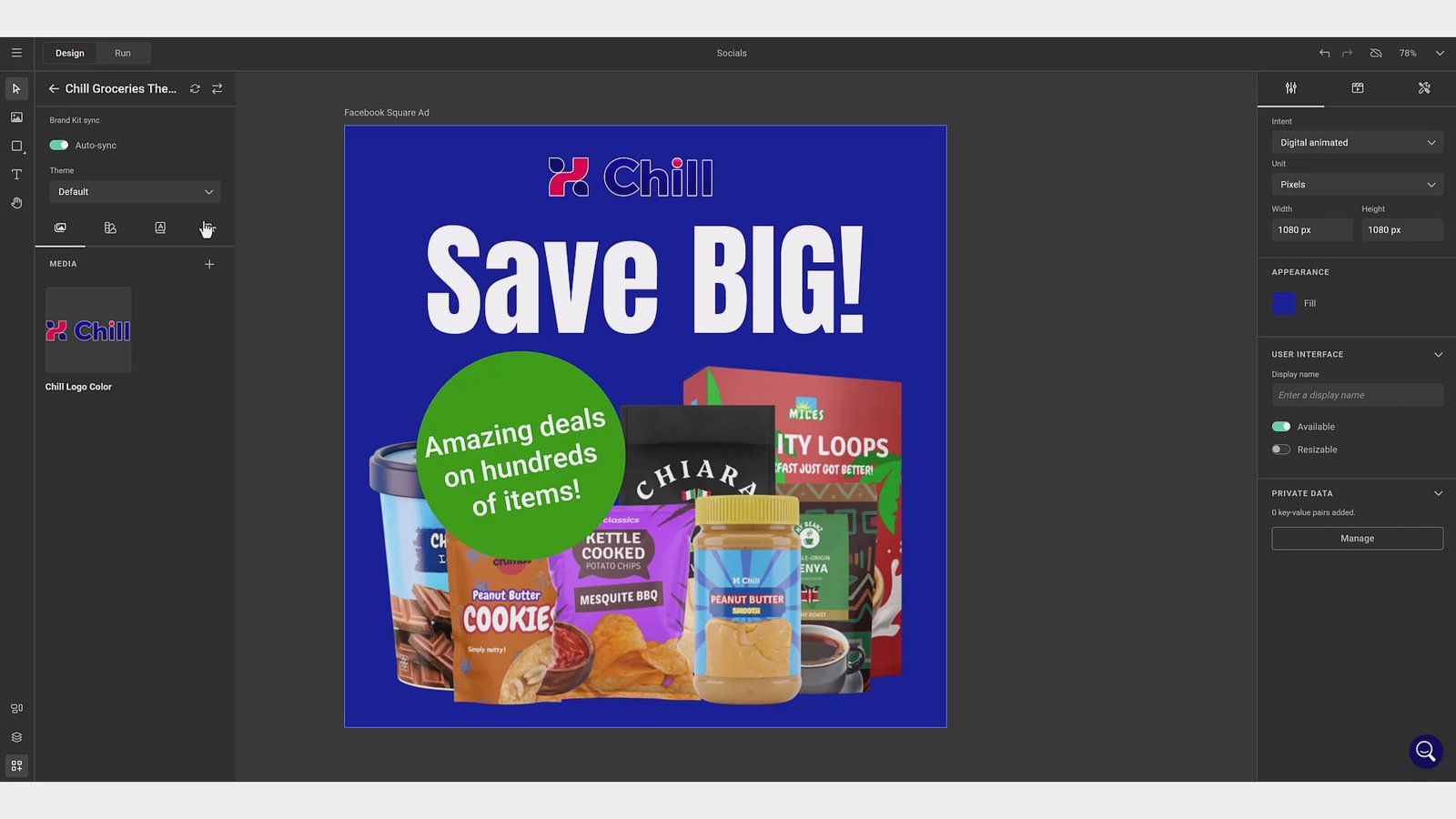
Components are reusable design elements you place inside templates. Build a pricing block, a product badge, or any branded element once – then drop it into as many templates as you need. When you update the component, every template using it updates automatically.
Place from the Resources panel: Add components directly into your template without rebuilding from scratch.
Multiple instances per page: Use the same component several times on a single page, each with its own independent data via variable mapping.
Full design system support: Each component carries its own layouts, Brand Kit, variables, and actions.
Flexible fill modes: Choose how a component fills its frame – Scale (matches by aspect ratio), Resize (uses anchoring and copyfitting), or Scale and resize (combines both).
The real power is in the update model. Change a component once, and every template that references it reflects that change automatically. For teams managing large template libraries across brands and campaigns, this is a significant reduction in repetitive production work.
Variable mapping is per instance – a template with three instances of the same component can give each its own independent data.
Template designers can now decide whether end users are allowed to crop images within a frame. It is a per-frame setting, disabled by default, so you opt in only where it makes sense.
When enabled, end users see a crop icon and can drag the image within the frame. The frame size and position stay fixed – so layout integrity is never at risk.
Fit, Fill, or Smart Crop frames: Each image gets its own individual crop.
Manual Crop frames: The crop area is shared across all images in the frame.
This gives production teams a precise way to open up creative flexibility for end users without compromising brand consistency or layout structure.
Connector Shared Header Value
For connector developers, there is now a way to set a header value that applies across all instances sharing the same remote connector ID. Pass a shared API key or session token once – without configuring it per instance. A small change that removes meaningful friction from connector setup and maintenance.
Font Size Constraint On by Default
When text editing constraints are enabled on a text frame, the font size constraint is now on by default. Previously it was off, which could produce unexpected results when restricting all text editing properties. This brings behavior in line with what designers actually expect.
Components alone make v1.40 a significant release for any team managing templates at scale. Combined with end-user crop control and a round of targeted fixes, this update moves GraFx Studio meaningfully forward – less repetition, more control, and more confidence in every output.
Know Your Templates Better: Creation and Modification Dates Now in the Environment API
When you're managing a growing library of templates across environments, keeping integrations in sync with what's actually changed – and when – can be a real challenge. Without reliable timestamp data, you're left guessing which templates are fresh, which have been updated, and which haven't been touched in months.
The CHILI GraFx Environment API now gives you that clarity.
Retrieve Template Timestamps Directly from the API
Two new fields are now available on template responses: DateCreated and LastModifiedContentUtc.
DateCreated – the date and time a template was first created in the environment.
LastModifiedContentUtc – the date and time the template's content was last changed.
Both fields are returned on the template list endpoint and the individual template endpoint:
GET /api/v1/environment/{environmentId}/templates
GET /api/v1/environment/{environmentId}/templates/{templateId}
No additional configuration required – the data is there when you need it.
What You Can Do With This
Timestamp data unlocks a range of practical use cases for developers and teams building on top of CHILI GraFx:
Sort by recency: Surface the most recently created or updated templates at the top of a list, so end users always start from the freshest design.
Detect changes since last sync: Use LastModifiedContentUtc to identify which templates have been updated since your integration last ran – making incremental sync workflows far more efficient.
Display audit information: Show creation and modification dates inside connected systems, portals, or dashboards where teams need visibility into template history.
Drive automation logic: Trigger downstream processes – approvals, notifications, or output jobs – based on when a template was last modified.
Built for Integration-Heavy Workflows
For teams running CHILI GraFx as part of a larger MarTech stack, this update removes a common friction point. Previously, tracking template history required workarounds or manual checks. Now, the information is available directly through the API – consistent, reliable, and ready to plug into whatever system you're building.
Whether you're maintaining a self-serve content portal, running automated batch output, or keeping an external asset management system in sync with your CHILI GraFx environment, DateCreated and LastModifiedContentUtc give your integration the context it needs to stay accurate.
Explore the full Environment API reference in the Developer Center.
Sharper, More Detailed Product Images – GraFx Genie Product Image Creator Just Got Better
The quality of your product visuals directly affects how your brand is perceived. Blurry edges, flat composition, or images that simply don't look polished enough – these are the kinds of details that erode trust before a customer even reads a word of copy.
The GraFx Genie Product Image Creator in GraFx Labs just raised the bar.
A Smarter AI Model, Better Results – Automatically
The AI model powering the Product Image Creator has been upgraded. The result: noticeably improved image quality across the board.
Product images now render with:
More accurate detail – finer textures, cleaner edges, and truer-to-life product representation
Better composition – outputs that feel considered and visually balanced
Sharper results – higher clarity that holds up at scale and across formats
And the best part? You don't need to change a thing. No new settings to configure, no workflow adjustments required. The improvement is built into the model itself.
What the Product Image Creator Does
For teams who haven't explored it yet, the GraFx Genie Product Image Creator is an AI-powered tool inside GraFx Labs that lets you generate and iterate on product visuals directly within CHILI GraFx.
You can:
Generate new images from a text prompt
Start from an existing brand-approved asset in GraFx Media and augment it
Upscale generated images for higher-resolution output
Save results locally or directly back to GraFx Media for reuse
Whether you need a fresh visual for a campaign or want to explore new directions without a full photoshoot, the tool gets you from brief to image in minutes.
Built for Experimentation, Grounded in Brand Control
The Product Image Creator lives in GraFx Labs – a dedicated space inside CHILI GraFx where experimental capabilities are available for teams to explore and validate before they become part of the core platform.
Good to know: GraFx Labs features are experimental. They can change or be removed at any time. The goal is to validate ideas and capture real-world feedback.
Generated images are charged as digital PNG renders, keeping billing transparent within your existing CHILI GraFx usage model.
If you've been using the Product Image Creator since its launch, this upgrade delivers meaningfully better output with no extra effort on your end. If you haven't tried it yet, now is a good time to start.
Manage Tags Programmatically: Tags API Endpoints Now in the Public Environment API
Template libraries grow fast. And when they do, the challenge shifts from creating templates to finding the right one at the right moment. Tags in GraFx Studio already solve that for designers working in the UI – now, the same organizational power is available to developers and integrators through the public Environment API.
Tags, Now Fully Accessible via API
Tags let you label and organize templates. You can group templates by brand, campaign, product line, or any other dimension that reflects how your team works.
Until now, managing tags was a manual process inside GraFx Studio.
That changes with this update. The Tags API endpoints are now part of the public Environment API, giving you full programmatic control over your tag vocabulary:
Create tags to build and extend your organizational structure automatically.
Update tags to keep naming consistent as your library evolves.
Delete tags to remove labels that are no longer relevant.
Assign tags to templates to keep your library organized at scale – without manual intervention.
All of this is available as part of your existing integration or automation workflow.
Why This Matters for Integrators and Automation Teams
For teams running high-volume content operations, manual tag management simply doesn't scale. When you're onboarding new brands, launching campaigns across regions, or ingesting templates from external systems, you need your organizational structure to keep pace automatically.
With Tags endpoints in the public API, you can:
Automate library organization as part of template ingestion pipelines – tags are applied the moment a template is created.
Sync tag structures across environments or with external systems, keeping everything consistent without manual overhead.
Build smarter integrations that surface the right templates to the right users based on dynamic tag filtering.
This is especially valuable for agencies managing templates across multiple brands, and for enterprise teams where template libraries span dozens of campaigns and channels.
Built on a Foundation Designers Already Use
The Tags API reflects the same logic that designers rely on in GraFx Studio. Tags are a management resource – they don't affect template behavior or output. They exist purely to help teams find and organize what they need, faster.
Now that foundation is fully accessible in code. Whether you're building a custom integration, automating content operations, or managing a library at scale, Tags give you a clean, flexible layer of organization that grows with your workflow.
Smarter Connector Management and a Cleaner Platform Experience in CHILI GraFx
Managing connectors across a growing environment shouldn't mean opening each one individually to check for updates, or navigating deep into settings just to set a default. This platform update removes those small but persistent friction points – and adds a few quality-of-life improvements that make working in CHILI GraFx feel more intuitive every day.
Know When a Connector Update Is Ready – Without Hunting for It
Connectors are how CHILI GraFx links your design workflows to the external systems your team already relies on – DAMs, PIMs, data sources, and more. Keeping them up to date matters. But until now, checking for available updates meant opening each connector individually.
That changes with update notifications. When a new version of an installed connector is available, a notification badge appears directly on the connector – both in the connector list and inside connector settings. You can see at a glance which connectors have an update ready, without any manual checking.
Instant visibility: Update badges surface right where you manage connectors.
No more manual checks: Spot available updates across all your connectors in one view.
Stay current with less effort: Keeping integrations up to date is now a matter of noticing, not searching.
Set a Default Connector in Fewer Clicks
Designating a default connector is a common task – and it used to require navigating into connector settings to do it. The Set as default option has moved to the three-dot menu directly on the connector list, putting the action exactly where you're already working.
The option is disabled automatically if the connector is already set as default, so there's no ambiguity about the current state.
Faster workflow: Set a default without leaving the connector list.
Less navigation: One less trip into settings for a routine action.
Clear status: The disabled state makes it obvious when no action is needed.
Dates Now Reflect Your Local Timezone
Date and time values in environment-level tables – including Tags and Output tasks – now display in your local timezone rather than UTC. If you ever need the original server time, hover over any date to see it in a tooltip.
This is a small change with a real impact: timestamps that actually match your working context make it easier to track activity, coordinate with your team, and understand when things happened.
New Resources Appear at the Top
Tags, output settings, output tasks, user interfaces, integrations, and subject types now sort by creation date descending by default. The most recently added items appear at the top of the list.
When you've just created something new, you shouldn't have to scroll to find it. This default sort order makes that a non-issue.
Connector Authentication Fix
A bug in connector Browser authentication has been resolved. Previously, setting Browser authentication to [None] while a Server authentication type was already configured incorrectly triggered a validation error. Browser and Server authentication can now be managed independently, without either configuration interfering with the other.
These updates reflect a consistent focus on reducing the small friction points that slow teams down. Better connector visibility, faster defaults, accurate timestamps, and smarter sorting – each one a step toward a platform that works the way your team actually works.
Every template designer knows the tension between giving end users creative freedom and keeping output on-brand. Too much freedom and layouts break. Too little and every small copy change becomes a support request. GraFx Studio v1.39 resolves that tension with a precise new set of text constraints – and adds a handful of improvements that make building and integrating templates faster and more reliable.
Text Constraints – Define Exactly What End Users Can Touch
Template designers can now set fine-grained constraints on text frames, controlling what end users are allowed to do when they open a template in Studio UI.
There are two layers of control:
Frame-level constraints – decide whether the text frame itself can be moved, resized, or rotated. Lock down the layout structure while still allowing the text content to be edited.
Inline editing constraints – let end users edit text directly inside the frame, with you choosing exactly which formatting options are available:
Paragraph styles – expose only the styles you've approved from your Brand Kit.
Character styles – same principle: you choose which are available.
Brand Kit colors – limit color choices to on-brand options only.
Font size – enable size editing with a configurable minimum and maximum range, so nothing goes too small or too large.
All constraints are disabled by default. You opt in only where it makes sense, frame by frame.
Inline editing is only available on text frames that do not use variables. Frames with variables continue to use the standard variable editing experience.
The result: end users get a focused, guided editing experience. Designers keep full control over brand consistency and layout integrity.
Building a multi-page document with similar layouts used to mean rebuilding each page from scratch. Not anymore.
GraFx Studio now includes a Duplicate option in the page context menu. Duplicate any page and use it as the starting point for a new variation – keeping your layout, frames, and structure intact while you adjust the content.
For teams producing brochures, catalogs, or any document where pages share a common structure, this is a meaningful reduction in repetitive work.
Anchored Frame Duplication Now Works as Expected
Duplicating a frame that uses anchoring now produces a correctly anchored copy. Previously, duplicated anchored frames could lose their anchoring configuration – making it unreliable to build layouts by duplication.
This fix makes anchored frame duplication a dependable part of your layout workflow.
Unique IDs in Template JSON – Better Foundations for Integrations
For developers building automations or integrations on top of GraFx Studio, this is a quiet but significant improvement.
Layout, page, and frame objects in the GraFx Studio template JSON now each carry a unique ID. That gives integrators a stable, predictable reference for every element in a template – useful any time you need to address a specific frame, page, or layout by ID in an automation workflow.
Text constraints alone make v1.39 a meaningful release for any team running self-serve content workflows. Combined with faster page duplication, reliable anchored frame copying, and a stable round of fixes, this update gives designers more tools to build templates that are both flexible for end users and consistent in output.
GraFx Experience 2.111: Govern Who Sees What Across Your Entire Portal
When a self-serve content portal grows to serve dozens of teams, regions, or brands, the question of access becomes critical. Who should see which templates? Which projects belong to which users? Without clear answers, portals become cluttered, workflows break down, and brand governance slips.
GraFx Experience 2.111 addresses this directly with global permission groups – giving administrators precise, application-wide control over what every user can access.
Global Permission Groups for Templates
Administrators can now define permission groups and assign them to users, controlling exactly who has access to templates, projects, and production outputs across the entire GraFx Experience application.
This is governance at scale. Rather than managing access on a case-by-case basis, admins build groups that reflect how their organization actually works – by team, region, brand, or role – and assign users accordingly. A user's effective permissions are the sum of the groups they belong to, so access can be layered and combined as needed.
What this means in practice:
Scoped template access: Users only see the Design Systems and layouts relevant to their role. A regional marketing team sees their market's templates; a global brand team sees everything they need.
Pre-configured field filters: Admins can configure field filters in the content store and project elements in advance, so users arrive in a focused, relevant workspace rather than an unfiltered library.
Personal work stays personal: Users always retain full access to the projects and production outputs they have created themselves – regardless of group configuration.
The result is a portal that feels purpose-built for each user, even when hundreds of people share the same environment.
Why This Matters for Distributed Teams
GraFx Experience is designed for organizations where content creation is distributed – franchises, field marketing teams, retail networks, or global brand operations. In those environments, showing every user every template is not just unhelpful, it creates friction and increases the risk of off-brand output.
Global permission groups close that gap. Admins shape what each user sees and does without changing the underlying content. The design system stays intact; only the view changes.
Also improved in this release:
Dark theme support on access denied pages: The 403 access denied page now respects the dark theme when enabled, keeping the interface consistent for users who prefer it.
Space chooser dropdown fix: The space chooser dropdown no longer appears behind the side menu in the editor, resolving a visual overlap that affected navigation.
Permission groups bring the same governance logic that powers GraFx Studio design systems into the GraFx Experience portal layer – so the right content reaches the right people, every time.
More Control Over AI-Powered Image Intelligence: Subject Types Now Accessible via API
Smart Crop and GraFx Genie's Vision AI don't work by magic – they work by understanding what to look for. Subject types are the user-defined categories, like "person" or "product," that tell the Vision AI where to focus in an image. Until now, managing those categories was a manual task. That changes with this Environment API update.
Retrieve and Update Subject Types Programmatically
You can now read and write subject type data directly through the API – for both media assets stored in GraFx Media and assets pulled in from external sources.
Retrieve all subject types at once:
GET /vision?expand=allSubjectTypes
Or query a specific subject type for a single asset:
GET /media/{mediaId}/vision/subject-types/{subjectTypeId}
GET /external-media/{externalMediaId}/vision/subject-types/{subjectTypeId}
Update subject types – individually or in bulk – using the extended endpoints:
PATCH /media/{mediaId}
PUT /external-media/{externalMediaId}/vision
No manual UI work required. The full read-write cycle for subject type data is now available in code.
Why Subject Types Matter
Subject types are the foundation of how GraFx Genie's Vision AI interprets your image library. When a subject type is correctly defined, Smart Crop knows exactly where to focus – keeping your subject centered, your layout intact, and your output consistent across formats and channels.
For teams managing large asset libraries or ingesting images from external DAM systems, maintaining accurate subject type data at scale has historically required manual intervention. With these new API endpoints, that process can be automated from end to end.
Automate subject type assignment as part of your asset ingestion pipeline – the moment a new image enters your environment, the right categories can be applied.
Sync Vision AI metadata across environments or with external systems, keeping Smart Crop behavior consistent wherever your assets are used.
Manage external media assets with the same precision as native GraFx Media assets – the external-media endpoints bring parity to both workflows.
Bulk update subject types when your categorization structure evolves, without touching each asset individually.
A Cleaner Font List in Your Integrations
This release also includes a small but meaningful improvement for integrations that surface font lists to end users. When a font preview can't be rendered, the list now displays fallback text instead of leaving a blank space.
It's a cleaner experience for anyone selecting fonts inside a connected portal or custom interface – no more unexplained gaps in the list. A full fix for fonts that still don't preview correctly is planned for a future release.
For teams building on top of CHILI GraFx, these additions extend the API's reach into one of the platform's most powerful AI-driven capabilities. Subject type control is no longer a manual step – it's part of your automation workflow.
No More Guesswork: Existing CHILI GraFx Users Now Get a Clear Invitation When Added to a New Subscription
Getting access to a new subscription should be straightforward. But for users who already have a CHILI GraFx account, the experience of being added to a second subscription could leave them wondering: did something change? Do I need a new login? Where do I even start?
A small but meaningful update to the CHILI GraFx Platform API removes that uncertainty entirely.
Existing Users Now Receive an Invitation Email
When an existing CHILI GraFx user is invited to a new subscription, they now receive an email notification that tells them exactly what they need to know:
The name of the subscription they've been invited to – so there's no confusion about which account or organization this relates to.
Clear guidance to sign in with their existing credentials – no new account to create, no password reset required.
It's a direct, informative message that gets users into the right place without friction.
Why This Matters
In organizations running multiple subscriptions – agencies managing several client accounts, enterprises with distinct business units, or teams expanding their CHILI GraFx footprint – users often need access across more than one subscription.
Before this update, an existing user added to a new subscription received no notification at all. They had no way of knowing access had been granted unless someone told them directly. That created unnecessary back-and-forth, support requests, and delays in getting people productive.
Now, the platform handles that communication automatically. The moment an admin adds an existing user to a subscription, the user is informed – with the right context and the right next step.
A Better Experience for Admins and Users Alike
For Subscription Admins and Environment Admins managing access across teams, this update means one less thing to coordinate manually. You grant access through the platform; the platform takes care of letting the user know.
For users, it means clarity from the start – a named subscription, a familiar login, and no ambiguity about what to do next.
This is the kind of improvement that doesn't change what the platform can do, but meaningfully improves how it feels to use it. Clear communication at the moment of access is a small detail that makes a real difference at scale.
GraFx Studio Photoshop Plugin 1.2.1: Smoother Imports for Complex Documents
Photoshop documents are rarely simple. Layers stack up, effects accumulate, and over time a working file can contain all kinds of structural quirks – including groups that carry effects but hold no layers inside them. Until now, that kind of document could stop a GraFx Studio import in its tracks.
Plugin 1.2.1 fixes that.
Empty Effect Groups No Longer Block Your Import
Some Photoshop documents include groups that have effects applied – such as Drop Shadow or Bevel & Emboss – but contain no layers inside them. These empty effect groups caused the import process to fail entirely, leaving teams unable to bring their work into GraFx Studio without first hunting down and removing the offending groups.
With this update, those empty groups are simply skipped during import. The rest of the document loads correctly, and your workflow continues without interruption.
No manual cleanup required: Affected documents now import without needing to be restructured first.
Reliable imports for complex files: Documents built up over time – with all their accumulated quirks – are handled more gracefully.
Less time troubleshooting, more time producing: The path from Photoshop to GraFx Studio stays clear.
Why This Matters
The GraFx Studio Photoshop plugin exists to bridge the gap between creative work done in Photoshop and the automation power of GraFx Studio. The goal is straightforward: bring your designs in, then let GraFx Studio handle the scaling, personalization, and multichannel output.
Anything that interrupts that import – even an edge case like an empty effect group – breaks the flow and adds friction for designers and production teams. This fix removes one more obstacle from that path.
If you've previously run into failed imports on documents with complex layer structures, this update is worth applying.
Find the Right Template, Instantly: Tags Are Now in GraFx Studio
The bigger your template library gets, the harder it becomes to find what you actually need. Scrolling past dozens of unrelated designs, relying on cryptic naming conventions, or asking a colleague which template is the right one – these are the small friction points that quietly slow production down.
Tags in GraFx Studio solve that.
Organize Your Library the Way Your Team Actually Works
Tags are labels you assign to templates. They have no effect on template behavior or output – they exist purely to help you organize and locate the right design, fast.
Template Designers and Environment Admins can now create a tag vocabulary that reflects how their team thinks: by brand, campaign, product line, region, or any other grouping that makes sense for their workflow.
Group by brand: Separate templates for different clients or brand identities at a glance.
Filter by campaign: Surface only the templates relevant to an active campaign, without digging through everything else.
Organize by product line: Give each product range its own tag so designers go straight to what they need.
A template can carry multiple tags, and tags can be created, renamed, or removed at any time without affecting template content or output.
From Dozens of Templates to Exactly the Right One
Here is how it works in practice. A team managing templates for two brands – say, Chill Home and Chill Chips – creates one tag per brand and assigns each template accordingly. A designer working on a Chill Chips campaign filters by that tag and immediately sees only the relevant templates. No scrolling, no guesswork.
Filtering is straightforward:
Open Templates in GraFx Studio.
Click the Filter icon in the toolbar.
Select one or more tags under By Tags.
The template list updates instantly to show only matching templates.
Need to clear it? One click on Clear all resets the view.
Built for Growing Libraries and Larger Teams
Tags are managed centrally under GraFx Studio > Manage > Tags – separate from templates, collections, and projects. You build your tag vocabulary once, then apply it across the library as it grows.
This separation matters. Tags are a management resource, not a content resource. That means they scale with your library without adding complexity to the templates themselves.
For teams already working with collections and user interfaces in GraFx Studio, Tags add another layer of precision – helping every designer, regardless of their familiarity with the full library, filter down to exactly what is relevant to their current work.
Who Can Use Tags
Template Designers and Environment Admins have full access to create, assign, rename, and delete tags. Tags are scoped to the environment, so each environment maintains its own organized tag vocabulary.
Note: Deleting a tag removes it from every template it was assigned to and cannot be undone.
As template libraries scale across brands, campaigns, and channels, the ability to find the right starting point quickly becomes a real productivity advantage. Tags give your team that clarity – no naming conventions required.
Clearer Billing Visibility and More Flexible Connector Management in CHILI GraFx
Knowing exactly what you're being billed for shouldn't require detective work. And configuring connectors shouldn't leave you stuck with settings you can't fully undo. This platform update addresses both – giving subscription owners sharper visibility into render usage and giving teams more control over connector authentication.
See Billable Renders Clearly – Across Every Environment
Renders are how CHILI GraFx measures platform usage, and understanding your actual billable output is essential for managing costs and forecasting accurately. Previously, watermarked renders were folded into the total renders count, making it harder to distinguish test or preview output from production renders that count toward your subscription.
That changes now. Watermarked renders are displayed as a separate category in the renders overview – at both environment level and subscription level. Subscription owners get a clear, honest picture of what's billable and what isn't, across all their environments in one view.
What this means for you:
No more guesswork: Billable renders and watermarked output are clearly separated.
Subscription-level clarity: See the full picture across all environments, not just environment by environment.
Accurate reporting: Make informed decisions about render quota and usage without manual reconciliation.
For developers and integrators, the Platform API reflects this change directly. The following endpoints now exclude watermarked renders from totalRenders and surface them via a new totalWatermarkedRenders property:
GET /api/v1/environments/{environmentId}
GET /api/v1/environments/{environmentId}/renders
GET /api/v1/subscriptions/{subscriptionId}
GET /api/v1/subscriptions/{subscriptionId}/renders
This keeps your dashboards, integrations, and reporting pipelines accurate without any additional workarounds.
Remove Connector Authentication – Fully, When You Need To
Connectors in CHILI GraFx link your design workflows to external data sources, media systems, and MarTech tools. Authentication is a key part of that setup – but until now, once you set an authentication type on a connector, you could only swap it for another. You couldn't remove it entirely.
That limitation is gone. A new [None] option in the Authorization dropdown lets you clear authentication from a connector completely. Select [None], save, and the existing authentication configuration is removed.
Why this matters:
Full configuration control: Adjust connector setups to match changing integration requirements without workarounds.
Cleaner connector management: Remove authentication when it's no longer needed, rather than replacing it with a placeholder.
More flexibility for developers: Iterate on connector configurations freely as your integrations evolve.
Introducing GraFx Labs: Explore the Future of AI-Powered Image Creation
What if you could test the next wave of AI-powered creative tools before they become part of the standard platform? That is exactly what GraFx Labs makes possible.
GraFx Labs is a dedicated space inside CHILI GraFx where Subscription Admins, Environment Admins, and Template Designers can explore and validate experimental capabilities. These features are designed to test functional value and technical feasibility – and your feedback shapes what comes next.
Good to know: Features in GraFx Labs are experimental. They can change or be removed at any time. The goal is to validate ideas and capture real-world feedback.
Two Experiments, One Goal: Better Product Visuals, Faster
The first release of GraFx Labs launches with two AI-powered experiments built on GraFx Genie. Both focus on a challenge that product and marketing teams face every day: creating high-quality product imagery at speed, without sacrificing brand control.
Experiment 1: GraFx Genie Product Image Creator
Need a compelling product visual – fast? The Product Image Creator lets you generate new images using state-of-the-art AI models, starting from either a brand-approved asset in GraFx Media or a prompt alone.
AI-powered image generation using leading models
Start from an existing asset stored in GraFx Media, or generate entirely from a prompt
Upscale generated images for higher-quality output
Save results locally or directly back to GraFx Media
Whether you need a fresh product visual or want to augment an existing one, this tool gets you from brief to image in minutes.
Experiment 2: GraFx Genie Product Image Composer
The Product Image Composer takes things a step further – giving you a controlled environment to build polished product shots by combining product images and backgrounds.
Background options:
Upload from your device
Select from on-brand assets in GraFx Media
Generate a scene from a prompt
Product image options:
Upload from your device
Use on-brand assets from GraFx Media
Generate on the fly with AI
Once you have your elements, a user-friendly composition interface lets you position and arrange everything into a ready-to-use product shot – all within a controlled, brand-aware environment.
Usage & Billing
Generated images are charged as digital PNG renders, keeping billing transparent and predictable within your existing CHILI GraFx usage model.
Why GraFx Labs Matters
GraFx Labs gives creative and production teams early access to capabilities that push the boundaries of what visual content automation can do. Rather than waiting for features to reach general availability, you can explore them now, validate them against real workflows, and share feedback that directly influences the platform's direction.
For teams already working with GraFx Genie's AI capabilities – from Smart Crop to background generation – GraFx Labs is the natural next step: a space to experiment with confidence, knowing the platform's brand controls and asset management are still in place.
Explore GraFx Labs and help shape what CHILI GraFx becomes next 🚀
Complex design systems are powerful – but when dozens of variables are wired across a layout, knowing exactly where each one lives can slow you down. GraFx Studio v1.38 solves that with smarter visibility tools, more expressive automation, and a round of stability improvements that keep your workflows running smoothly.
Instantly See Where Every Variable Is Used
Building a sophisticated design system means managing a lot of moving parts. Variable highlighting makes that significantly easier.
Select any variable and GraFx Studio will highlight every place it appears directly on the layout – no guesswork, no hunting through layers. You can review, validate, and adjust with full confidence before publishing or handing off to production.
Instant visual feedback: See all variable placements at a glance.
Faster validation: Confirm your design system logic is wired correctly before output.
Fewer errors: Catch misapplied or missing variables early in the process.
This is especially valuable for design system creators managing large, data-driven templates across multiple channels.
Pick the Right Asset, Faster
Working with large media libraries just became more efficient. Asset names now appear as tooltips in media-related panels, giving you the context you need to choose the right image without opening each one individually.
Tooltip previews: See asset names on hover, right inside the panel.
Faster selection: Reduce clicks and second-guessing when browsing large libraries.
Better workflow for design system creators: Keep production moving without interrupting your creative focus.
Programmatic Color Control Across Output Channels
Automated templates often need to adapt colors based on output – screen versus print, brand variant versus campaign. You can now set color values directly in actions using RGB, Hex, and CMYK color spaces.
Full color space support: RGB, Hex, and CMYK – all available in actions.
Consistent on-brand output: Apply the right color automatically based on output requirements.
Smarter automation: Let your design system handle color logic, so end users and production teams don't have to.
This gives design system creators and developers precise, programmatic control over color across every output scenario.
Reliability Fixes That Keep Production on Track
v1.38 also delivers a focused set of fixes that improve day-to-day stability:
Smart Crop improvements: More consistent image placement based on subject area settings in GraFx Media.
Undo stability: Resolved several issues that caused unexpected behavior when undoing actions, including cases involving frame deselection.
Studio UI polish: The H shortcut is disabled for projects with constraints to prevent accidental conflicts; page offset timing issues are resolved; and range constraint tooltips now display the correct configuration.
Render count accuracy: Watermarked renders are now displayed correctly, keeping quota tracking reliable.
GraFx Studio v1.38 is about working with greater clarity and control – whether you're mapping variables across a complex design system, automating color for multichannel output, or simply trusting that your undo history behaves as expected. Smarter tools, fewer surprises, and more confidence at every step.
Precise PDF Output: Advanced Postprocessing Controls Now in the Environment API
Color accuracy and PDF standards compliance are non-negotiable in professional print and publishing workflows. The latest Environment API update delivers exactly that – giving developers and production teams fine-grained control over PDF version, color transformation, and ICC profile embedding, all configurable directly through the API.
Choose Your PDF Standard – Explicitly
Different downstream systems, printers, and archiving workflows have different PDF compatibility requirements. You can now define the exact PDF version your output targets, removing any ambiguity from the generation process.
PDF Version Selection via postProcessing.pdfVersion: Choose from PDF 1.4, 1.5, 1.6, or 1.7 to match the requirements of your print provider, distribution channel, or document management system.
Predictable Compliance: No more guessing which standard was applied – your output conforms to exactly the version you specify.
This is especially valuable for regulated industries, archival workflows, and integrations where PDF version compatibility is a hard requirement.
Control Color Conversion with Precision
Color consistency across channels and devices is one of the hardest problems in print production. The Environment API now gives you direct control over how color transformation is applied during PDF generation.
Configurable Color Transformation via postProcessing.colorTransformation: Define both the intendedIccProfile and the destinationIccProfile to precisely govern how colors are converted during output.
Intended vs. Destination Profiles: Specify where your colors are coming from and where they need to land – ensuring accurate, device-ready output every time.
Consistent Results Across Runs: With explicit profile definitions, color behavior is repeatable and predictable across every batch job.
Whether you're targeting FOGRA-certified print, a specific press profile, or a custom destination, this level of control means your PDFs arrive print-ready – without manual correction steps.
Embed the Right ICC Profile in Every PDF
Output Intent embedding is a critical part of color-managed PDF workflows, particularly for print-ready files. The Environment API now supports configurable Output Intent embedding.
ICC Profile Embedding via postProcessing.colorProfileEmbedding.iccProfile: Define which ICC profile is embedded in the generated PDF, ensuring downstream tools and RIPs interpret color data correctly.
Standards-Compliant Output: Embedded profiles communicate color intent clearly to printers, prepress teams, and automated production systems.
End-to-End Color Integrity: From design system to final PDF, your color management chain stays intact.
Learn More
Dive deeper into color management concepts and output configuration in the official documentation:
With these advanced postprocessing controls, the Environment API puts professional-grade PDF production directly in your hands – precise PDF standards, accurate color transformation, and embedded profiles, all defined in code and delivered at scale 🚀
Richer Visual Effects: Improved Gradient & Drop Shadow Support in GraFx Studio Plugins
Bring more of your creative intent from Adobe® tools straight into GraFx Studio! The latest plugin improvements deliver stronger support for gradients and drop shadows, helping designs translate more faithfully while staying fully compatible with Design Systems and scalable templates.
Design with Confidence: More Accurate Visual Translation
Gradients and shadows are essential for depth, hierarchy, and polish. These updates ensure that when designs move from desktop tools into GraFx Studio, they retain their visual structure and behavior – reducing manual fixes and speeding up production.
The result: cleaner imports, predictable templates, and less rework for Template Designers and production teams.
Adobe® InDesign® Plugin: Gradients and Shadows That Stay True
Gradients authored in Adobe® InDesign® now translate with greater accuracy:
More Shape Coverage: Apply gradients to rectangles, triangles, and ovals.
Rotation Preserved: Gradient angles are respected during import.
Reverse Gradients Supported: Maintain intended light and color direction.
To ensure consistency, GraFx Studio supports Linear gradients in Classic gradient mode. Other gradient types are automatically converted to PDF to preserve visual fidelity.
Drop Shadows with Predictable Behavior
Drop shadows from InDesign now carry over with robust parameter support:
Works Across Objects: Shapes, image frames, and text frames.
Key Parameters Preserved: Opacity, distance, angle, size (mapped to Blur in the GraFx Studio UI), and global light.
InDesign-Specific Accuracy: X and Y offsets are respected, ensuring shadows land exactly where intended.
This means more depth and realism in your templates – without surprises after import.
Photoshop gradients now translate with improved clarity and control:
Supported Shapes: Rectangles, triangles, and ovals.
Rotation & Direction: Gradient angles are preserved.
Additional Controls Supported: Scale, align with layer, and reverse.
Consistent Standards: Linear gradients in Classic gradient mode ensure predictable output.
Reliable Drop Shadows Across All Objects
Drop shadows are supported on shapes, image frames, and text frames, with faithful translation of:
Opacity
Distance
Angle
Size (Blur)
Global Light
A clear warning is shown when drop shadows are present, keeping Template Designers informed about any unsupported parameters.
Why This Matters: Less Rework, More Control
These improvements focus on what matters most in high-volume and automated workflows:
Higher Fidelity Imports: Visual effects retain more of their original structure.
Faster Template Readiness: Spend less time fixing gradients and shadows after import.
Design-System Friendly: Effects remain compatible with scalable, controlled templates.
By preserving depth, contrast, and visual hierarchy from your Adobe® designs, GraFx Studio helps you move from creative concept to production-ready template faster – and with confidence.
Keep your gradients smooth, your shadows sharp, and your workflows efficient with these latest GraFx Studio plugin enhancements 🚀
Scale Production with PDF Multi-File Output and Parallel Rendering via the Environment API
High-volume PDF generation just became faster, more flexible, and easier to control. With the latest Environment API enhancements, you can confidently handle large batch jobs by splitting outputs into predictable file sizes and rendering them in parallel – all designed for enterprise-scale automation.
Break Large PDF Jobs into Manageable Files
When generating thousands of records in a single run, file size and processing limits can quickly become a bottleneck. The Environment API now gives you precise control over how PDF output is packaged.
Controlled File Sizes with maxRecordsPerFile: Define how many records are included per PDF file, automatically splitting large batch jobs into multiple, easier-to-handle outputs.
Operational Flexibility: Optimize PDFs for downstream systems, archiving, or distribution workflows without custom post-processing.
Predictable Results at Scale: Large exports are no longer all-or-nothing – each file is generated with consistent limits you define.
This is ideal for transactional documents, catalog generation, or any scenario where volume and reliability matter.
Faster Throughput with Parallel PDF Rendering
Speed matters when processing at scale. Parallel rendering is now enabled for PDF outputs via the Environment API.
Higher Throughput: Multiple PDF files are rendered simultaneously, significantly reducing total processing time for large jobs.
Improved Reliability: Distributed rendering helps balance load across workers, making high-volume output more resilient.
Built for Automation: Perfect for scheduled jobs, integrations, and continuous production pipelines.
You can explore the available options directly in your tenant’s Swagger documentation:
Behind the scenes, internal handling of large and complex data sources has been strengthened to support distributed rendering more reliably.
More Robust Worker Coordination: Better stability when processing complex or data-heavy jobs.
Improved Resilience at Scale: Ongoing hardening ensures consistent behavior across a wide range of configurations and data sizes.
Note: Extremely aggressive configurations – such as very low maxRecordsPerFile values combined with very large external datasets – may still encounter upstream limits like API rate limiting.
What This Means for You
With multi-file PDF output and parallel execution, the Environment API now empowers you to:
Process larger volumes with confidence
Maintain predictable PDF sizes
Reduce turnaround time for batch exports
Design more resilient, scalable output workflows
Whether you’re powering automated document generation or enterprise-grade publishing, these enhancements give you the control and performance needed to scale without compromise 🚀
Rock-Solid Template Updates: Environment API Reliability Improvements
Build and scale with confidence using the latest Environment API improvements. This update focuses on reliability, clarity, and predictability – especially for teams running high-volume, parallel operations across templates and environments.
Reliable Template Updates – Even Under Heavy Load
When multiple processes update the same template at the same time, consistency is critical. The Environment API now handles these situations with greater care, ensuring your data stays clean and trustworthy.
Sequential Save Handling: Concurrent updates to the same template are now processed in order, preventing race conditions and incomplete saves.
Consistent Template Storage: Every update is fully applied before the next begins, protecting templates from partial or conflicting changes.
This is especially valuable for automated workflows, batch processing, and integrations where templates are updated at scale.
Clearer Error Reports for Faster Troubleshooting
Understanding what went wrong should never slow you down. Error reporting from the Environment API is now easier to read and easier to act on.
Predictable Error Ordering: Error report records are returned in a consistent, human-friendly sequence.
Easier Record Matching: Quickly map errors back to their original input records – even when processing many items in parallel.
The result: faster debugging, clearer logs, and smoother operations for developers and platform teams.
Stability Fixes That Protect Your Templates
Behind the scenes, important fixes further strengthen API reliability:
No More Overlapping Save Risks: Simultaneous template updates no longer leave templates in inconsistent or partially updated states.
These improvements reduce operational risk and help ensure every API-driven update delivers exactly what you expect.
Explore the Environment API
Dive deeper into endpoints, behavior, and usage details in the official documentation:
With these Environment API enhancements, you can scale automation, integrations, and concurrent workflows with greater confidence and clarity – knowing your templates are always protected 🚀
Image Constraints, Smarter Lists, and more in GraFx Studio v1.37
Design with greater confidence and precision in GraFx Studio v1.37! This release delivers powerful new controls for image frames, smarter list styling, and important text stability improvements – all focused on protecting layouts, speeding up editing, and keeping templates predictable at scale.
Lock It Down: New Constraints for Image Frames
Protect your designs from accidental edits and ensure consistent output across every user and channel. GraFx Studio now lets Template Designers apply constraints to image frames, giving you fine-grained control over how images behave inside templates.
Controlled Resizing: Prevent unwanted stretching or scaling that can break carefully designed layouts.
Restricted Movement: Lock image positions to maintain alignment and structure.
Rotation Safeguards: Disable rotation where precision and brand consistency matter most.
These constraints are ideal for high-volume or self-serve templates, where design integrity must be preserved no matter who edits the content.
Smarter, Faster Lists: Enhanced Numbered and Bulleted List Controls
Lists just got more powerful and easier to manage – especially for content-heavy templates.
Character Styles for Numbered Lists: Apply character styles directly to numbered list formats and symbols, giving you full typographic control and perfectly on-brand numbering.
Keyboard Shortcuts for List Levels: Increase or decrease list levels instantly using keyboard shortcuts, making structured content faster to build and easier to refine.
Improved Multi-Level Formatting: Four numbered list levels now come with predefined, independent formatting. The fourth level no longer inherits from the first, ensuring clarity and visual hierarchy even in complex documents.
The result: cleaner lists, faster editing, and better consistency across every template.
Text You Can Trust: Stability and Overflow Protection
Text-heavy templates benefit from important safeguards that reduce surprises and layout issues.
Maximum Text Length Enforcement: Text variables now respect defined length limits, preventing overflow and protecting layouts from breaking when content changes.
More Reliable Text Behavior: Improvements ensure consistent handling when replacing text or working with auto-grow frames.
These updates help ensure your templates stay visually stable – even when populated dynamically or edited by non-designers.
Polished Details: Fixes That Improve Everyday Workflows
GraFx Studio v1.37 also includes a wide range of fixes that quietly improve reliability and precision:
Consistent Subscript and Superscript Styling: Uniform behavior across inline, paragraph, and character styles.
Correct Frame Positioning: Newly created frames now appear exactly where expected.
Accurate Aspect Ratio Handling: Aspect ratio restrictions no longer apply when an object is disabled.
Smoother Auto-Grow Resizing: Text frames resize correctly when auto-grow is enabled.
Studio UI Improvements: Constraints That Carry Through
The Studio UI now fully supports and enforces image frame constraints defined in GraFx Studio, ensuring the same rules apply during editing as during template design.
No More Layout Shifts: Date picker error messages no longer cause disruptive UI movement.
GraFx Studio v1.37 is all about control without complexity – stronger guardrails for images, more expressive lists, and text behavior you can rely on. Build smarter templates, reduce rework, and deliver consistent, on-brand results every time 🚀
Streamline your day-to-day platform management with the latest platform improvements! This update focuses on clarity, accessibility, and reliability, giving administrators and integrators better visibility, faster configuration, and clearer feedback when things matter most.
Faster Access, Smarter Configuration at Environment Level
Managing environments just became more intuitive. Key environment settings are now easier to find and use, helping teams move faster and reduce friction.
Environment Settings at Your Fingertips: Access environment-specific settings directly from a dedicated gear icon in the left navigation. No more hunting – critical configuration is always within reach.
Copyable Technical Environment Name: A new input field lets you instantly copy the technical environment name, making integrations, API usage, and configuration tasks quicker and less error-prone.
These enhancements are designed to save time, reduce setup complexity, and support smoother collaboration between platform admins and technical teams.
Clearer Versioning for Better Focus
The GraFx Studio version display has been refined to highlight what truly matters.
Simplified Version Format: Version numbers now follow a clean major.minor.x structure, reducing visual noise and helping you quickly understand the significance of updates at a glance.
This makes it easier to communicate changes internally and stay aligned across teams.
Reliability Improvements That Keep You Moving
Behind the scenes, important fixes ensure a more predictable and frustration-free platform experience:
Accurate Role Handling: Users with combined EA and CA roles are now correctly redirected to the template page, eliminating confusion during navigation.
Clearer Template Import Errors: When a template upload fails, improved error reporting provides clearer insight into what went wrong – so issues can be resolved faster.
Column Power: Effortless Multi-Column Text Layouts in GraFx Studio v1.36
Unlock editorial design excellence with GraFx Studio v1.36! Whether you're a Template Designer seeking modern magazine flair or a marketer building structured, scalable layouts, our newest release brings total control to your text blocks – all with familiar, intuitive tools.
Multi-Column Text Frames: Transform Your Content in Seconds
Elevate your templates with beautifully structured text. You can now split text frames into multiple columns, achieving classic editorial looks, elegant data presentations, or simply a more organized vibe – all within a single frame:
True Flexibility: Choose the number of columns that suits your layout, from streamlined two-column spreads to detailed multi-column grids.
Custom Spacing: Easily adjust the gap between columns for perfect visual rhythm and brand alignment.
Seamless Scaling: Enjoy all existing auto-resize and overflow controls – columns adapt dynamically, maintaining design integrity across every scenario.
Faster Editing: Reflow, balance, and update content with zero-copy, hassle-free workflow, speeding up magazine layouts, brochures, and info-rich templates.
Precision Improvements: Character Style Font Handling
GraFx Studio v1.36 also polishes your creative workflow with smart fixes:
Character Style Clarity: If a character style uses the font family "[None]", the font-style dropdown is now empty and disabled. This prevents confusion and ensures you always know exactly how your text styles are behaving.
Supercharge your editorial layouts, build smarter templates, and enjoy a smoother design experience with GraFx Studio v1.36! 🎉
Smarter Text Styling & Bulletproof Reliability: Numbered Lists and More in GraFx Studio v1.35
Unlock clarity, consistency, and enhanced reliability with GraFx Studio v1.35! This release delivers advanced list styling, upgraded error messaging, and valuable improvements for seamless integration and worry-free editing. Whether you're a Template Designer or integrating GraFx Studio into your workflow, you'll find new ways to create on-brand, professional content with confidence.
Organize Content with Ease: Flexible Numbered Lists in Paragraph Styles
Say goodbye to manual formatting! Multi-level numbered lists are now built right into GraFx Studio paragraph styles, making it simple to present information, instructions, or features with clarity and precision.
Multi-Level Support: Structure your content with up to nine levels of numbering for clean, organized layouts.
Custom Formats: Pick the number format, add your own symbols, and fine-tune indents to match your brand and design guidelines.
Consistent Branding: Apply numbered lists across your templates without losing cohesive styling or formatting control.
Enhanced List Controls: Bullet Icons That Match Your Brand
Take your bulleted lists to the next level! GraFx Studio now offers improved bullet rendering:
Font Precision: Bullet icons automatically adopt the correct font from their assigned character style, ensuring on-brand typographic consistency.
Smart Fallbacks: If you haven't set a character style for bullets (or set its font to None), GraFx Studio uses the paragraph style's font – so your lists always look just right.
Working in complex environments or building advanced integrations? GraFx Studio v1.35 improves reliability and your ability to spot problems fast:
Transparent Studio Loading Errors: If GraFx Studio hits a configuration or engine load snag, you'll get a clear in-app message so you know what to do next – no guesswork required!
Empowering Integrators: The new onLoadError event enables integrators to listen for and analyze load failures (such as engine issues), supporting more robust automation and troubleshooting.
Non-TypeScript Validation: Integrations that don’t use TypeScript benefit from added configuration validation. When an issue is detected, GraFx Studio halts loading and alerts you directly in the app and the browser console, so problems are never hidden.
Plus: Productivity-Boosting Fixes & Refinements
GraFx Studio v1.35 includes several under-the-hood fixes and improvements to ensure smoother operation and a seamless user experience.
Level up your text styling, rest easy with reliable error handling, and enjoy a smoother editing experience – all with GraFx Studio v1.35! 🚀
Seamless Transparency: Opacity Imports from Adobe® InDesign® & Photoshop® Now in GraFx Studio
Unlock perfect creative fidelity between your Adobe® workflows and GraFx Studio! With the newest enhancements to our Adobe® InDesign® and Adobe® Photoshop® plugins, importing professional layouts is now smoother than ever – preserving every layer with transparency and visual effect with precision.
Effortless Opacity Import for Total Visual Consistency
Take the guesswork out of migration. GraFx Studio now automatically retains object opacity settings when you import designs from Adobe® InDesign® and Adobe® Photoshop® – guaranteeing that your templates look exactly as intended, every time.
Across Every Element: Transparencies on shapes, text, and images are carried over, so gradients, faded objects, and overlays remain flawless.
Respect for Layers & Blends: Multi-layer compositions and blend mode behaviors are faithfully translated, letting you maintain professional detail and vibrant depth across projects.
Save Hours of Manual Fixes: Skip the tedious task of reapplying transparency or layering effects by hand – your creative context is preserved instantly upon import.
Predictable Output, Polished Templates
Now, when moving creative assets from Adobe tools into GraFx Studio, you can trust that all visual dynamics – from subtle shading to bold overlays – stay intact. This means:
Reliable Template Creation: Consistent transparency eliminates surprises, making automated output and brand templates visually predictable and on brand.
Faster Workflows: Get started on production layouts in GraFx Studio right away, without fixing missed opacity settings.
Seamlessly move your layered designs into GraFx Studio – and keep every subtlety, every effect, every time. Experience next-level compatibility and creative continuity today! ✨
Effortless Text Styling & Sharper Controls: Bulleted Lists and More in GraFx Studio v1.34
Elevate your template designs and streamline your workflow with GraFx Studio v1.34! The latest release introduces advanced text styling, smoother frame control, and enhanced HTML output options – all built to help you achieve professional, on-brand results faster and easier than ever.
Create On-Brand Lists with Powerful Bulleted List Support
Bring extra polish and organization to your layouts! GraFx Studio v1.34 adds robust bulleted list support within paragraph styles. Now, Template Designers can easily define and apply bulleted lists that perfectly match your brand identity and design system.
Unified Design: Seamlessly apply bulleted lists through paragraph styles, ensuring consistency across all layouts and campaigns.
Tailored Visuals: Assign a character style to the bullet itself for total creative control – customize shape, size, and color so every list feels on brand.
Effortless Editing: Manage list styling and layout centrally, saving time and ensuring accuracy across multiple projects.
Fine-tune your layouts with surgical precision. The improved frame selection tools bring new power to editing densely layered templates:
Cycle Through Overlapping Frames: Use Ctrl/Cmd-click to navigate through the stacked frames at your cursor – no more frustration with hidden elements!
Crystal Clear Selections: Multi-selection now collapses to the topmost frame, allowing for faster and more accurate adjustments during complex design sessions.
HTML Output: Visual Consistency That Goes Anywhere
The Experimental HTML renderer in GraFx Studio takes another leap forward! HTML output now fully supports frame opacity, delivering pixel-perfect transparency and overlays just as you see them in your native layouts.
Consistent Branding Across Channels: Your designs maintain their look and feel anywhere HTML output is used – be it web, signage, or digital campaigns.
No Surprises: Preview, export, and deploy with confidence, knowing your creative work stays visually true in every environment.
Stay ahead of the curve with every release. With GraFx Studio v1.34, you unlock more creative flexibility, sharper editing tools, and the confidence to deliver flawless, on-brand content for every project! 🌟
HTML Output, Frame Opacity Mastery, and More in GraFx Studio v1.33
Unlock powerful new possibilities and elevate your creative output with GraFx Studio v1.33! This release introduces HTML export for versatile, omnichannel digital content, powerful frame opacity controls, and an array of workflow refinements designed to supercharge your design process.
Experience Total Flexibility: HTML Output for Templates
Unleash your designs outside static file formats! GraFx Studio v1.33 debuts HTML output (Experimental), enabling you to export dynamic templates as HTML. Imagine powering digital signage, web campaigns, or interactive experiences – all straight from your GraFx Studio dynamic layouts.
Frictionless Digital Integration: Export your creative assets as ready-to-use HTML for displays, websites, or partner solutions.
Maximize Template Value: Repurpose your designs across screens and channels, without extra manual steps.
Add polish, depth, and elegant overlays to your layouts! GraFx Studio now supports frame opacity (alpha channel) on all frame types. Infuse your templates with subtle transparency or bold layered effects – perfect for modern branding and dynamic visual storytelling.
Effortless Overlay Effects: Fine-tune transparency for text, images, and shapes to create standout visual moments.
Layer with Precision: Build rich backdrops and highlights with fully customizable opacity settings.
GraFx Studio v1.33 includes a host of smart enhancements:
Error-Proof Design: Automatic warnings appear if your template uses a misconfigured font via a GraFx Connector – so you can quickly resolve issues and keep work on track.
Work Faster: Instantly duplicate any frame with the new ALT + Drag shortcut, making creative experimentation swift and easy.
Clearer Usability: Users on small screens (below 768px) now receive an in-app alert about minimum size requirements – maximizing your experience, wherever you create.
Gradient Nirvana: Remove gradient stops by simply dragging them out for ultra-smooth editing. And GraFx plugins now support gradient imports, letting you move creative assets seamlessly between platforms.
Effortless Project & Mobile Navigation
Staying organized and productive is just a tap away:
Enhanced Project View: Switch between new list and grid modes, search, and sort your GraFx Studio projects with ease. See more on managing your projects.
Smarter Mobile UX: Benefit from a fresh navigation menu and optimized avatar menu on mobile, built for faster access and smoother touch interactions.
Bring your templates to more screens, layer visuals like a pro, and move faster than ever – all with GraFx Studio v1.33! ✨
Brilliant Gradients & Smarter Automation: New Enhancements in GraFx Studio v1.32
Bring your designs to life and experience unbeatable workflow improvements with GraFx Studio v1.32! This release adds breathtaking linear gradients, rapid variable creation, and major upgrades to GraFx Genie – all designed to help you work smarter, design faster, and deliver flawless results.
Dazzle with Linear Gradients – Now for Every Shape
Ready to make your templates pop? GraFx Studio v1.32 introduces powerful linear gradient support for all shape frames. Layer vibrant or subtle color effects directly into your Smart Templates for truly custom branding and knockout visuals.
Total Color Freedom: Use CMYK, RGB, Hex, or Spot Colors to fine-tune your gradients and keep every asset perfectly on brand.
Designer-Controlled: Intuitively apply and adjust gradients for backgrounds, overlays, and accents – all within an optimized workflow.
Say goodbye to tedious manual variable setups. With the new Create Variables from Datasource option in the UI, you can instantly generate variables straight from your linked data – accelerating template prep and reducing errors.
Rapid Data Onboarding: Map datasource content to template variables in seconds, cutting down repetitive work.
And for single-line text, you can now prevent line breaks to keep layouts clean and brand-compliant – discover how in the official guide.
GraFx Genie: Unleash Longer, Smarter Prompts
GraFx Genie is now more capable than ever:
More Room for Your Imagination: Input up to 4000 characters per prompt, giving you all the space you need for detailed instructions or creative coding ideas.
Smarter Context Handling: Genie now recognizes your selected triggers and intelligently prevents circular references, ensuring effortless and accurate automation every time.
Smoother, Faster, and More Reliable Than Ever
You asked, we delivered. GraFx Studio v1.32 packs in a host of performance enhancements and vital fixes, including:
Accelerated Loading: Open documents faster – and stay productive even on complex projects.
Seamless Indic Language Support: Accurate rendering for a wider array of languages ensures everyone’s message shines.
Cleaner UI Interactions: No more stray resizing cursors during text edits, and improved mobile tray scrolling for perfect usability, everywhere.
Rock-Solid Data Integrity: Number variables now block invalid (non-finite) values, so you never have to worry about saving errors or broken data flows.
Effortless Media Browsing: Nested folders now work flawlessly in the variable image picker, giving you deeper and more organized asset access.
Check out GraFx Studio v1.32 and experience the beauty of gradients, speedier data-driven design, and next-gen automation with GraFx Genie. Create, customize, and collaborate at scale – all while your workflow runs smoother than ever!
Dramatic Depth & Smoother Workflows: Drop Shadow Arrives in GraFx Studio v1.31
Elevate every visual with new creative power in GraFx Studio v1.31! This release introduces dynamic Drop Shadow support across all frame types, along with significant workflow and stability improvements – helping you craft standout designs, deliver seamless experiences, and work faster than ever.
Add Impact Instantly: Now with Drop Shadow for Every Frame
Give your designs dimension and polish with the all-new Drop Shadow effect for any frame in GraFx Studio. Whether you’re creating social posts, displays, or custom layouts, Drop Shadow lets you add professional depth and emphasis with just a click.
Universal Coverage: Apply Drop Shadow to any frame – text, images, or shapes – for ultimate design flexibility.
Effortless Branding: Enhance your brand identity and template creations with subtle shading or bold emphasis, always perfectly on-brand.
This release also improves artwork import via plugins:
Plug & Play Imports: Import invisible frames via plugins and retain your complete design structure.
Smarter, Friendlier Studio UI
Editing and uploading assets just got more intuitive with enhanced feedback and controls:
Clear Upload Status: Enjoy a smoother image upload experience with visible spinners and a "Loading preview" message, so you always know exactly what’s happening.
No Overlaps, No Hassle: Uploading or browsing is now paused until your current upload finishes, preventing accidental missteps.
Helpful Error Messages: Instantly see actionable, clear error alerts for missing assets or access issues – reducing confusion and saving time.
Expanded Data Control: Work at scale with increased datasource page size (now up to 50 rows per page) for more efficient data browsing and selection.
Reliability You Can Count On
Crash-Free Loading: Experience stability improvements that eliminate loading errors in GraFx Studio.
Connector Consistency: Enjoy seamless search functionality across more GraFx Connectors.
Smoother Editing: Error-free deleting even during frame moves means nothing slows down your creative flow.
Step up your creative impact and streamline your workflows with GraFx Studio v1.31 – where standout visuals and efficient production go hand in hand. Ready to see your templates pop? Try out the Drop Shadow effect and discover smarter control, every step of the way! 🎨
Effortless Design Precision: Text Stroke & Smarter Controls in GraFx Studio v1.30
Level up your creative toolkit with GraFx Studio v1.30, delivering sharper design control, enhanced workflows, and brand-new ways to perfect your templates.
Bold Typography, Your Way: Text Stroke in GraFx Brand Kits
Now you can make headlines, tags, and calls to action stand out like never before. With the new text stroke option for Paragraph and Character styles available in GraFx Brand Kits, Template Designers can add an extra layer of typographic impact – all while keeping every element perfectly on brand.
Consistent Styling: Ensure every Brand Kit delivers the same crisp, outlined text wherever it’s used.
Limitless Creativity: Highlight key messages, create eye-catching effects, or improve readability with just a click.
Seamless Imports: The Brand Kit importer now recognizes and applies text stroke, making migration smoother than ever.
Smarter GraFx Studio Controls for Faster, Flawless Design
GraFx Studio introduces new controls built for speed, flexibility, and clarity. Here’s how your workflow just got better:
Proportional Layout Lock: Keep designs perfectly scaled with the new option to restrict proportions to layout settings, ensuring on-brand consistency across every asset.
Constrain Proportions in Studio UI: Resize images and elements with confidence, knowing they’ll stay in proportion every time you make adjustments.
Clearer Guidance: Benefit from detailed help text for GraFx Connector media configuration, making setup and troubleshooting a breeze.
Intuitive Interactions: Instantly see the resizing cursor when you hover over frame borders, so you always know where and how to adjust your designs.
Performance Boost: Experience faster load times and smoother editing in templates with many variables – perfect for complex, data-driven campaigns.
Refined AllLayouts View: Navigate and manage your layouts with even more clarity in the Studio UI.
🛠️ Fixes & Enhancements
Effortless Image Sizing: Clear minimum and maximum sizes easily during image uploads for more flexible asset management.
Reliable Media Downloads: Improved stability for mediaConnector.download calls.
Visual Consistency: Blend modes now render more accurately, and layer fill colors reset as expected when undoing overrides – so what you see is always what you get.
Craft every asset with precision. With GraFx Studio v1.30, you’re equipped to create on-brand, standout designs – faster and easier than ever. Try the latest features and see your templates shine!
Seamless Creative Automation: Import InDesign® and Photoshop® Exports via GraFx Studio API
Connect your favorite creative tools directly to GraFx Studio and unlock a whole new level of automation and flexibility for your design team!
✨ Smarter Integrations with the GraFx Studio API
Accelerate your creative workflows with the enhanced GraFx Studio Environment API. Now you can seamlessly import Adobe® InDesign® and Photoshop® export packages through the API – giving you end-to-end control over your design automation.
What does this mean for your business?
Integrated Workflows: Move your designs effortlessly from Adobe® InDesign® or Photoshop® into GraFx Studio as Smart Templates, ready for instant reuse and personalization.
Accelerated Go-To-Market: Eliminate manual hand-offs – automate the import process and keep your creative pipeline moving at top speed.
Total Flexibility: Develop custom integrations and connect GraFx Studio to the systems and tools your team already loves, from DAMs to e-commerce platforms.
Transform design hand-offs into a thing of the past. The GraFx Studio API brings Adobe® creative assets straight into your automated content workflow, so you can create, adapt, and deliver at scale – with zero friction. 🚀
Streamlined Asset Management in GraFx Studio: Simultaneous Upload & Browse Now Live
Managing creative assets in GraFx Studio just became easier and more intuitive than ever. With the v1.29 update, end users can now upload and browse assets at the same time – directly from the GraFx Studio interface.
✨ Upload and Browse, Side by Side
Say goodbye to workflow interruptions. With the new Image Variable enhancements, you can now upload new graphics into your designated GraFx Media folders and instantly browse all available assets – all from a single place.
Here’s how this empowers your team:
Frictionless Personalization: End users no longer have to choose between uploading or browsing – both options are available side by side, making it fast and convenient to find the perfect image for any template.
Seamless Configuration for Template Designers: Template Designers gain ultimate flexibility by configuring Image Variables that support both browsing and uploading. You decide which GraFx Media directories are available for each action – giving total control over asset management and creative guardrails.
Consistent Brand Experience: Whether reusing on-brand images or introducing new content, teams maintain brand consistency with complete oversight of where assets are stored and accessed.
Enhanced User Experience
Form Builder Improvements: Enjoy a smoother, more responsive configuration process with the latest refinements to Form Builder.
UI Fixes: Download popups are now perfectly aligned when the back button is removed, ensuring a polished, professional experience every time.
Discover the new standard in creative asset management – where flexibility meets control – in GraFx Studio v1.29!
Ready to simplify and supercharge your team’s creative process? Try out the new simultaneous upload and browse features today!
Custom Forms, Your Way: Introducing the GraFx Studio UI Form Builder
Designing for others just got a whole lot easier. The new User Interface Form Builder in CHILI GraFx Studio empowers Template Designers to take full control of the end-user experience – no code required.
Whether you’re streamlining workflows for global teams or clarifying creative requests for clients, the Form Builder lets you decide exactly what users see and how they interact with your Smart Templates in My Projects.
What Sets the Form Builder Apart?
Customizable Input Panels – Choose which sections – like Data Sources, Layouts, and Variables – are visible to each user.
Tailored Guidance – Rename sections and add help text, eliminating confusion and ensuring every brand guideline is followed.
Seamless User Experience – Enable or disable features like layout selection and resizing, all while previewing the end-user interface in real time.
Frictionless Personalization – Hide unnecessary options to keep things clean, focused, and on-brand every time.
Why You’ll Love It:
Picture this: Your local marketers open My Projects and see only what’s relevant to them – no clutter, no questions, just an intuitive form that guides them through personalization. Faster turnarounds, fewer errors, and complete brand control – all thanks to an experience you configured in seconds.
Release Highlights
Full Layout Control: Define exactly what your users see and do in My Projects.
Real-Time Interface Preview: Instantly see changes as you configure the form.
Mobile-Ready: Improved support for seamless media switching on mobile devices.
Smoother Workflows: Plus, bug fixes for a glitch-free Run mode experience.
Ready for next-level template management? Explore the Form Builder and reimagine how end users engage with your Smart Templates in GraFx Studio.
Introducing the GraFx Studio Exporter for Adobe® Photoshop®
Ready to take your creative workflows to the next level? We’re excited to unveil an all-new, experimental plugin designed to make it easier than ever to bring your Adobe® Photoshop® projects directly into GraFx Studio as Smart Templates.
Transform your Photoshop designs into dynamic, reusable templates – without leaving your favorite tools!
Why You’ll Love It
Lightning-fast multi-artboard export – Effortlessly export multiple artboards of the same size as multi-page GraFx Studio templates. Perfect for complex projects, presentations, or digital publications.
Creative confidence, guaranteed – Preflight checks flag unsupported features and suggest smart fixes or seamless PDF conversion for flawless results every time.
All your creative assets, perfectly preserved – Enjoy robust support for blending modes, vector shapes, and RGB/CMYK color modes, ensuring your designs look exactly as you intended.
Streamlined workflow – Export all unique document colors as versatile GraFx Studio color resources, and automatically skip hidden layers for a cleaner finish.
⚡ This plugin is available in Experimental mode – get early access to the latest innovation and help shape its future! Learn more about Experimental releases.
Ready to Get Started?
The GraFx Studio Photoshop Exporter works with Adobe® Photoshop® 2024 and 2025, with ongoing testing on version 25.0 (January 2025).
Pro Tip: Want to see how easy it is to convert other Adobe documents? Check out our handy guides for converting Photoshop files and InDesign documents into GraFx Studio Smart Templates!
Turn your Photoshop brilliance into shareable, flexible templates – right inside GraFx Studio. Get started today!
Exciting Updates in CHILI GraFx v1.28: Enhanced Performance, Flexibility & Mobile Experience!
Discover What's New in CHILI GraFx v1.28!
Get ready for a smoother, faster, and even more powerful visual content automation experience with our latest CHILI GraFx release! Here’s what you can look forward to:
✨ Enhanced Features for Maximum Productivity
Customizable Brand Kits: Now you can easily remove unnecessary styles from your Brand Kits, giving you more flexibility and control over your brand assets.
Optimized Mobile View: Enjoy a seamless workflow on any device. Our mobile improvements mean on-the-go editing and approvals have never been easier.
Lightning-Fast Performance: We've dialed up the speed, ensuring CHILI GraFx is more reliable and responsive than ever – so you can focus on creating, not waiting.
Smarter SDK Integration: Integrate CHILI GraFx into your systems with greater efficiency, thanks to our enhanced Software Development Kit.
Bugfixes for a Flawless Experience
Smooth Media Management: Issues with specific media folder names are a thing of the past – organization is now effortless.
Reliable Form Builder Defaults: Creating forms is more intuitive with properly set default options every time.
Check out CHILI GraFx v1.28 today and experience creative automation at its best! Questions or feedback? Let us know and let's create something amazing together!
Smarter Templates: Automated Copy Cleanup for Word-Perfect Content Production
Nothing slows down automated content production like awkward gaps and empty lines from missing data. With GraFx Studio v1.28, your Smart Templates just got smarter:
Empty variables? The paragraph disappears – instantly and automatically.
This new release ensures your automated assets always look polished and professional, even when certain data fields (like a missing product description, disclaimer, or promo code) aren’t available. No more empty spaces or broken layouts – your copy flows naturally, every single time.
What’s in the release:
Automatic Paragraph Removal: If a variable is empty, GraFx Studio now simply eliminates the entire paragraph for you – no manual clean-up needed
Cleaner Automation at Scale: Run high-volume, variable-driven campaigns with confidence – every layout looks intentional and on-brand
Engineered for Speed & Stability: Performance upgrades and bug fixes mean you get more done, with fewer hiccups
How it works
Automating at scale? Just set your template to remove paragraphs linked to empty variables. From digital ads to catalogs, your designs stay “client-ready” automatically.
Experience frictionless, high-velocity production with the new GraFx Studio – where smart automation delivers professional results, no matter what your data looks like.
Introducing GraFx Genie Vision: Smarter. Sharper. More Powerful.
Experience a new era of visual intelligence with GraFx Genie Vision! Our latest update supercharges your creative workflow, delivering even smarter image insights and precision recognition – so you can focus on what matters most: results.
✨ What’s New: See More, Do More
Enhanced Contextual Recognition: Now, Genie Vision recognizes a broader range of objects – like houses and buildings – allowing you to pinpoint assets with unprecedented accuracy. Whether you’re managing real estate images or cityscapes, you’ll find exactly what you need, faster.
What’s Improved: Sharper Person Detection & Reliable Results
Person Detection: Enjoy more reliable tagging and identification, making it seamless to curate people-focused collections.
Logo Detection Removed: Say goodbye to false positives! We’ve eliminated logo detection for cleaner, more relevant search results.
Eye Detection Upgrades: Genie Vision now locates points-of-interest on faces with even greater accuracy for stunning, perfectly framed results, every time.
Note: These improvements apply to new assets or those never processed before - so your freshest content gets all the benefits instantly!
Maximize Genie Vision with Smart Crop
Ready to harness next-level composition? Dive into:
Introducing GraFx Brand Kits: One-Click Brand Consistency Across Every Design
Your brand, everywhere – beautifully consistent. GraFx Brand Kits are here to make on-brand creative production faster (and easier) than ever before.
Define your brand once. Apply it everywhere.
Build your Brand Kit in GraFx Studio to centralize your core brand ingredients: logos and imagery, color palettes, fonts, and both character and paragraph styles. Now every designer – and every template – can instantly stay on-brand, no matter how fast you’re creating or how often your assets evolve.
What does this mean for you?
Lightning-fast template creation: Choose your Brand Kit, and every template inherits the right styles and elements – no more manual setup or brand guidelines hunting.
Always on-brand: Scale up creative production with total confidence. Every team, every output, fully aligned.
Effortless updates: Tweak your Brand Kit and see changes reflected instantly across future design work.
Text Stroke: Make typography pop with sharp, precisely-rendered outlines – perfect in the editor and in print/PDF. Fine-tune the look for impactful, readable text anywhere.
Indic-Language Support: Go global with native support for Devanagari and more, enabling inclusive design for diverse audiences.
⚡ Designer Productivity Upgrades
Sticky Variable Settings: Rename variables without losing your place or settings panels - keeping workflows smooth and efficient.
🔧 Engine Enhancements
Auto-Extraction of Translatable Strings: Templates are more localization – ready than ever.
Smoother Canvas Repaints: Enjoy crisper visuals and faster, more fluid editing experiences.
🐛 Fixes & Polish
Template previews now perfectly match final output.
PDF text strokes retain perfect alignment.
"Save As" always includes your chosen file name.
No more orphaned styles after undo.
General performance and stability boosts.
With GraFx Brand Kits and the latest GraFx Studio improvements, creative teams can scale faster, produce more on-brand content, and go global with freshly streamlined workflows.
GraFx Studio v1.26: Global-Ready, More Precise, and Effortless Design Automation
Our latest release of GraFx Studio brings your creative automation to the next level, making the platform even more accessible, intuitive, and powerful – no matter where or how you work.
🌏 Create Without Language Limits
Say hello to true global reach! GraFx Studio now fully supports Indic scripts like Hindi (and more), with accurate shaping and rendering for complex characters. It's never been easier to create on-brand content in every market, language, and script – including right-to-left languages like Arabic and Hebrew.
🎨 Design Smarter, Crop Faster
Per-Asset Cropping Refined: Enhanced tools give you pixel-perfect control for every asset, with reliable previews so you can see every change – no surprises at output.
Multi-Frame Visibility Controls: In one click, show or hide multiple frames to streamline your canvas and focus on what matters.
Accurate Color Every Time: The color picker now displays both name and hex values, so you choose (and confirm) exactly the right brand colors, instantly.
🗂️ Asset Management, Reimagined
Smarter Metadata Mapping: We've overhauled the mapping pop-up for easier navigation – find and connect data fields with confidence.
GraFx Brand Kits: Say goodbye to “GraFx Stylekits” – all your brand assets live in the new GraFx Brand Kits, for clear, consistent brand governance.
💡 UI Improvements to Keep You Flowing
Contextual Tooltips: Get instant, in-place help while reviewing or editing, so your team moves from question to answer – without missing a beat.
Placeholder Guidance for Variables: Unclear where to enter content? Multiline variable fields now feature placeholder text, making template usage self-explanatory.
Field Auto-Grow: Variable and text fields expand smoothly as you type, so you always see exactly what you’re working on.
Localized Variable and Layout Names: Template UIs are now accessible in your team’s language.
Min/Max Helper Text: Layout size controls now show allowed ranges – no more trial and error.
Flawless Image Uploads: Strict min/max constraints and error handling for asset uploads to ensure print- and web-ready results every time.
Timeline and Layout Fixes: Animation and layout tools are more precise and reliable than ever.
CHILI GraFx Studio v1.26 brings a boost for every creative workflow, letting your team design and automate like global pros with unmatched ease and precision. Ready to create without limits? Try the latest features with a free CHILI GraFx Discovery environment – branding just got smarter, faster, and more universal.
We're excited to bring you the newest enhancements to GraFx Publisher, designed to streamline your workflow and deliver even more reliability for your publishing projects!
What’s New & Improved?
Lightning-Fast Organization: Moving folders and files in the back-office is now quicker and more dependable. Effortlessly rearrange your content with confidence – no waiting or hiccups!
Smoother and More Reliable
Tree Level Assurance: Enjoy peace of mind knowing that folder structure limits are now always enforced as expected, keeping your projects neat and organized.
Google Sheets Integration – Now Flawless: We’ve fixed authentication issues that could block your Google Sheets data connection. Now, bringing dynamic data into your pages is seamless and dependable.
Make the most of GraFx Publisher’s power and flexibility – your streamlined publishing journey starts here!
Let Everyone Upload Their Own Images: Branded Personalization at Scale
Now anyone can make every template their own. With the new Custom Image Upload feature in CHILI GraFx Studio (v1.25), you can empower users to upload their images directly into your branded templates – unlocking a new level of personalization and creative freedom.
How It Works:
Template designers can enable image upload – from logos and team photos to unique artwork, end-users can insert personal visuals right in the Studio UI.
Perfect for letting franchisees add local team shots, for campaign teams to insert fresh product photos, or for any situation where user-generated content drives engagement and authenticity.
Choose whether users can browse your DAM, upload their own, or coming-soon, combine both for ultimate flexibility.
Use Cases:
Localize event collateral with real team photos in minutes
Give resellers self-serve access to co-branded marketing material
Run contests or UGC-driven campaigns that pull images straight from your audience
Release Highlights
User-Powered Personalization: Every asset can be unique, on demand
Seamless Experience: Direct image upload in the Studio—no jumping between platforms
Brand Control: Designers set the rules; users add the personal touch
✨ Unleash Precision with Cropping Power in GraFx Studio!
Image perfection, on your terms. With GraFx Studio v1.24, cropping is smarter – and more customizable – than ever before. Whether you’re designing dynamic templates or perfecting details, our latest release puts the power of pixel-perfect storytelling right at your fingertips.
Manual Crop Override: Your Vision, Locked In
Want absolute control over how your visuals are framed? Now, Template Designers can lock specific images to a manual crop, even when using automated Smart Crop modes. That means:
Every time you use the image in that specific layout, your chosen crop is perfectly preserved.
Effortless automation, plus the finesse of a human touch – so every asset looks its best, no matter who loads it.
No more guesswork. Instantly preview how your assets will be cropped – directly from the asset details in your workspace. The result? Faster workflows, more confidence, and fewer interruptions.
Smoother, Faster, Better
Enhanced stability and performance for seamless media processing.
Continuous improvements to image handling and text rendering – your creative process, elevated.
Ready for flawless crops and lightning-fast workflows? Check out GraFx Studio v1.24 and experience the next level of creative control!
Batch Output to MP4 & GIF: Scale Up Your Animated Asset Production
Ready to take dynamic content production to the next level? GraFx Studio now supports batch output for all major formats – including MP4 and GIF.
You’ll enjoy all the automation power you love for PDF, PNG, and JPG, now extended to video and animated graphics. Imagine generating hundreds or thousands of unique social posts, display ads, or email banners – each as a fully rendered MP4 or GIF – instantly and at scale.
Effortless Animation at Scale
Turn any data source into a campaign – output a personalized MP4 or GIF for every record in your dataset
Activate batch output for all supported formats directly in your Output Settings
Automate delivery to teams or platforms – no more manual rendering or exporting
Built for Reliability
We've upgraded error handling for MP4 and GIF outputs, so your batch runs are just as dependable as your static assets. Confidently create high-volume animated content without extra review or rework.
Perfect for:
Social media managers looking to push high-impact video content to every market
Retail and ecommerce teams automating flash sale ads or personalized product animations
Anyone ready to say goodbye to hand-crafted animation exports and hello to automated scale
Get started in minutes. Point your data, toggle your output settings, and watch GraFx Studio handle the rest – all in your favorite formats.
Reach your audience with powerful on-brand motion graphics, wherever and whenever you need them.
Seamlessly Connect GraFx Studio with Keepeek DAM – Meet Your New Media Connector!
🚀 Introducing the GraFx Studio – Keepeek Media Connector!
Open up a whole new world of creative possibilities with the latest addition to our open source Connector library, thanks to our trusted partners at Graphique Alliance.
With the Keepeek Media Connector, you can now effortlessly link your Smart Templates in GraFx Studio directly to your Keepeek Digital Asset Management (DAM) system.
Why You'll Love It
Streamline Your Workflow: Instantly access and use your Keepeek media assets – right inside GraFx Studio.
Boost Collaboration: Empower your team to create on-brand visuals faster, with all assets always up to date.
Open Source Freedom: Join a growing community leveraging open Connectors for maximum flexibility.
GraFx Studio: Effortless Batch Export to PNG & JPG is Here!
Create Brilliance at Scale: Batch Export Images with GraFx Studio
Say goodbye to manual file conversions! With our latest GraFx Studio update, you can now instantly generate batches of high-quality PNG and JPG images – right alongside your favorite PDF exports.
Simply toggle the data source option in your output settings, and watch as GraFx Studio automatically creates an image file for every record in your dataset. It's seamless, fast, and designed to supercharge your workflow.
But that's not all: we've enhanced our error handling for PNG and JPG outputs, matching the reliability you already trust for PDFs. Focus on your creativity – we'll take care of the details.
GraFx Studio v1.23: Elevate Your Designs with Arabic Support & Multi-Line Text
Create Without Limits – Introducing GraFx Studio v1.23
The latest GraFx Studio update is here to supercharge your creativity and keep your workflow smarter than ever. Version 1.23 is packed with game-changing features and enhancements – designed to help you communicate across languages, manage complex templates, and enjoy a smoother design experience from start to finish.
What’s new in GraFx Studio v1.23?
Seamless Multi-Line Text
- Add rich, multi-line text variables to your templates for maximum flexibility. Whether it’s a quote, address, or anything in between, your text looks great and stays organized every time.
- [Learn how to use multi-line text variables →](https://docs.chiligrafx.com/GraFx-Studio/guides/template-variables/multi-line-text/)
Arabic Language & RTL Support
- Your designs, now in Arabic! With right-to-left text rendering and beautiful ligature support, GraFx Studio empowers you to create culturally-relevant, accessible content for Arabic-speaking audiences—effortlessly.
Consistent Output for Designers & Users
- Enjoy peace of mind. All template output is now streamlined and limited to Run mode in the designer workspace, ensuring reliability and predictable results for everyone.
Enhanced Frame Visibility Controls
- Get clearer template management with new yellow eye icons marking frame visibility overrides—easy to spot, easier to reset with layout inheritance controls.
Smarter Page Navigation in Design Mode
- Effortlessly switch between pages on multi-page templates using new navigation controls right on your canvas.
Faster, Sharper Image Loading
- Experience improved image loading with enhanced media connector performance and upgraded image preview visuals.
Extra Performance & Usability Fixes
- Enjoy a more reliable design platform with a suite of bug fixes and behind-the-scenes improvements.
Upgrade to GraFx Studio v1.23 today and bring your multi-language, multi-line design visions to life.
CHILI GraFx Environment API: Smoother Asset Management, Now Better than Ever
Accelerate Your Creative Workflow with the Latest Environment API Enhancements
The CHILI GraFx team is excited to announce important updates to the Environment API – delivering an even more streamlined and reliable experience for managing your design assets.
What's New?
Clearer Media Support: Easily upload images with confidence! The Environment API now fully supports image/png and image/jpeg formats, so your assets are always ready and compatible.
Smarter File Management: Keep your projects light and efficient. All external asset uploads are now capped at a versatile 10MB – perfect for high-quality images without slowing you down.
Improved Stability & Usability
Effortless Resource Management: Searching for assets just got easier! Enhanced filtering ensures you find exactly what you need, exactly when you need it.
Flawless Organization: Say goodbye to upload snags. Special characters in file and folder names are now handled seamlessly – your library stays organized and accessible.
Ready to experience more reliable, intuitive asset management?
GraFx Studio Unveils Powerful New Adobe® InDesign® Plugin Update – Boost Your Creative Workflow!
Elevate Your InDesign Projects with the Latest GraFx Studio Plugin Update!
Supercharge your design process with the newest GraFx Studio plugin release for Adobe® InDesign®! We’ve packed this update with must-have features to help creative pros like you work smarter, faster, and with more precision than ever before.
Here’s What’s New:
Intuitive Image Alignment Controls
- Gain ultimate control over how images are positioned within frames. Achieve the perfect fit and alignment to bring your design vision to life, effortlessly.
Smarter, Safer Exports with Preflight Checks
Say goodbye to costly mistakes! Our enhanced exporter preflight checks help you catch issues before they become problems, ensuring flawless output every time.
Stunning Visual Effects with Blending Options
Get creative with new blending capabilities now supported during export. Easily add depth and sophistication to your layouts.
Enhanced Design Validation
The expanded preflight system means broader, more robust checks for total peace of mind and print-ready results.
Polished Performance & Bug Fixes
Enjoy a smoother experience thanks to numerous general improvements and enhancements under the hood.
Canto Connector for GraFx Studio: Automated Creative Production for your Canto DAM assets
Managing assets in Canto has always been easy. Now putting them to work in your visual content automation is too!
The new CHILI GraFx Connector for Canto is a direct pipeline between your DAM and design automation – bringing approved assets and metadata straight into GraFx Studio.No downloads. No rework. Just seamless, on-brand production at scale.
Real-World Use Case
Here’s how it works when your team manages assets in Canto (think product photos, logos, and lifestyle imagery, etc.):
A designer opens a Smart Template in GraFx Studio and pulls in approved visuals directly from Canto
Metadata, like SKUs or promo dates, flows automatically into the layout
Local teams personalize the template for their region in just a few clicks
That’s self-serve design, powered by your DAM-approved assets.
Release Highlights
Direct Asset Access – Browse and place Canto assets in GraFx Studio
Smart Metadata Sync – Automatically map SKUs, pricing, categories, and more
Localization Support – Serve the right content by market or region
Seamless Collaboration – One connected source for designers and marketers
Already using Canto? Try the Canto Connector for GraFx Studio in a free CHILI GraFx Discovery Environment – we’ll set you up to test how seamlessly your assets and metadata flow into Smart Templates, using your own instance of Canto.
Not using Canto? No problem. CHILI GraFx supports a growing ecosystem of community-created Connectors for other leading DAM platforms and data sources too.
From Google Sheets to Personalized, On-Brand Assets at Scale
Got a massive dataset? Want to automate asset production at scale for a digital shelf, direct mailing campaigns, or high-volume personalized marketing? The Google Sheets Connector for GraFx Studio makes it possible to generate tens of thousands – even millions – of graphical assets at unprecedented speed.
Linking Google Sheets to your GraFx Studio Smart Template happens automatically. Each column header instantly matches a template variable – like customer details, product data, pricing, or even personalized QR codes. And, just like that, you're ready to generate millions of personalized, on-brand assets.
Release Highlights
Easy Data Connection: Link a Google Sheet to your template with just a URL.
Automation Options: Run batch output from either the UI or via the API for fully automated workflows.
Smart Preview Mode: Preview and check individual records before running large-scale batch output.
Build Your Own Connectors: The CHILI GraFx open-source Connector Framework makes it easy to create custom integrations from any dataset source.
The Google Sheets Connector for GraFx Studio is the first example of our new Data Connector Framework – an open-source foundation that allows developers to build custom Connectors for any data source. That means Google Sheets is just the beginning!
Test it yourself in a free CHILI GraFx Discovery environment! With ready-to-use content to explore, you can experience the true meaning of graphics production at scale.
Stop drowning in static asset management – start generating visuals dynamically. With the new Sitecore Content Hub Connector for GraFx Studio, your creative and marketing teams can instantly access and use on-brand, approved assets from your DAM in CHILI GraFx. No bottlenecks, no outdated assets – just high-impact graphics, ready to go.
Once again, CHILI GraFx has solidified its position as the go-to Creative Automation platform, seamlessly connecting with DAMs, PIMs, and other essential content supply chain systems. Boost your workflow efficiency and maximize your return on creative tech investments with CHILI GraFx!
Release Highlights
Direct Access to Assets: Template Designers as well as end-users can browse and select assets from Sitecore Content Hub without leaving GraFx Studio.
Metadata Synchronization: Stay consistent with automatic synchronization of asset metadata, ensuring accurate information across platforms.
Localized Metadata: Indicate your locale and the Connector will automatically load asset metadata in your language.
Better Team Collaboration: Empower designers and marketers with a unified workspace for asset use and Smart Template creation.
Increased Asset Use: Maximize the impact of your Sitecore Content Hub by making approved assets instantly available in your creative production workflows.
Setting up the CHILI GraFx Connector for Sitecore Content Hub is quick and secure – just configure authentication, and you're ready to instantly access assets .
Looking for more integrations? The CHILI GraFx Connector Framework enables partners to build Connectors between their technologies and CHILI GraFx, expanding connectivity across the content supply chain.
Find out more about Sitecore and how to set up the Connector using the following links.
Adjusting images for different channels is time-consuming, but Smart Crop eliminates the hassle. Powered by purpose-built AI, CHILI GraFx now instantly identifies the subject and the Point of Interest (POI) within the image then automatically crops it to fit the frame – whether for social media, digital ads, or print.
And while Smart Crop automates precision at scale, you stay in control: You can fine-tune the subject position within the frame, crop manually, or override the image's AI-generated data with your preferred adjustments.
Release Highlights
Effortless Multichannel Adaptation: Automatically adjust image crops for any channel—social, digital, or print.
AI-Driven Precision: Keeps the focus where it belongs, enhancing every design.
Customizable Controls: Easily refine or override the POI to fit your exact needs.
With Smart Crop, GraFx Genie delivers another AI solution to make creating at scale faster and smarter. Say goodbye to manual versioning and hello to precision-driven automation.
Faster Smart Template Creation: The InDesign® Plugin Is Here!
GraFx Studio now integrates seamlessly with Adobe® InDesign®, making it easier than ever to transform your designs into dynamic, multichannel templates. Whether you're working on print, digital, or animated projects, this plugin will streamline your workflow while enhancing creative efficiency.
From designers leveraging familiar tools to teams automating scalable template production, the InDesign plugin bridges the gap between creativity and powerful automation.
Release Highlights
Seamless Importing: Effortlessly transition your InDesign designs into GraFx Studio, unlocking advanced scaling and personalization capabilities.
Preflight Functionality: Prepare your designs for multichannel output with a clear overview of compliance or potential issues in GraFx Studio.
Designed for Print Experts: Purpose-built to meet the high standards of print professionals, while also expanding capabilities for digital and animated outputs.
The InDesign plugin accelerates Smart Template creation, combining the best of both worlds – creative flexibility and powerful automation. Ready to see it in action? Request access to your CHILI GraFx Discovery environment today!
Grow With Ease! With Text Frame Auto-grow in GraFx Studio
Our new Auto-grow feature simplifies managing dynamic text content in your templates by ensuring your text frames are always optimally visible, with no manual adjustments needed! It's an incredible feature that gives you full flexibility to decide how your text frames behave as layouts change.
With Auto-grow, the text frame itself automatically resizes when needed, all while respecting a maximum height limit. This means the text frame resizes correctly for your design then copyfitting can step in to ensure that the content of the frame also resizes. Both methods make sure no part of your text gets cut off... or shrinks into obscurity!
Auto-grow also works seamlessly with anchoring to a frame. When a text frame expands, any anchored frames automatically adjust, keeping your layout intact as content shifts.
Release Highlights
Dynamic frame adjustment: Text frames auto-expand as content grows, up to a preset limit.
Complete text control: Changes in text, font size, and style are applied automatically based on your variables.
Anchored Content: Layout spacing and frame sizes adjust automatically as text frames resize.
With Auto-grow, you can stay focused on your design and content, while GraFx Studio handles the text frame adjustments for optimum content visibility.
GraFx Studio Upgraded Its Status – From Single to Multi!
GraFx Studio now supports multi-page layouts, unlocking new possibilities for your designs. Create brochures, folders, and other multi-page documents – all seamlessly within one design workflow.
From creative agencies designing high-quality brochures to retailers producing localized promotions, multi-page layouts are perfect for creating impactful, multichannel designs that maintain brand consistency.
Release Highlights
Easy Page Management: Add, delete, and reorder pages with simple click and drag functionality.
Visibility Controls: Hide or show pages as needed – only visible pages appear in the final output.
Streamlined Editing: Variables update across all pages instantly for total consistency.
With multi-page layouts, along with AI-driven resizing features like Auto-grow and advanced anchoring, GraFx Studio delivers unmatched efficiency and simplicity – making it the ultimate tool for creating professional, dynamic, multichannel-ready designs. Start exploring the possibilities today!
GraFx Studio now offers PDF Crop Marks for your print production workflows. This essential addition ensures accurate page trimming when preparing your designs for print. PDF page boxes, configured for print production, are also fully supported as part of this update.
What are Crop Marks?
Crop marks are lines printed in the corners of your artwork that indicate to a printer where the paper should be trimmed. They ensure the final print product is cut to size and eliminate unwanted fringe areas around your designs.
**How it Works in GraFx Studio: **
Enabling crop marks is simple. Toggle the "Crop marks" option in the PDF output settings, and customize the offset and weight of the crop marks to match your specific requirements:
Offset: Control the distance between the crop marks and the edge of the (Media) page.
Weight: Adjust the thickness of the crop marks for optimal visibility.
GraFx Studio uses default settings recommended by the Ghent Workgroup (GWG) of offset (3mm) and weight (0.25pt).
Benefits:
Accurate trimming: Eliminate errors and ensure your designs are cut with precision.
Streamlined workflow: Reduce time spent on manual adjustments and communication with your printer.
Professional results: Deliver polished and print-ready artwork at any scale every time.
Technical Details:
PDF Page Boxes: Setting crop marks also sets PDF page boxes (Media, Trim, Bleed, Crop, and Art) for print production, ensuring compatibility with industry-standard print workflows.
Registration Color: Crop marks are printed in "Registration color" (100% of all process and spot colors) to guarantee visibility on all color plates.
White Background Offset: Crop marks include a white background offset for enhanced visibility on darker backgrounds.
**Ready to cut to the chase? **
Start using PDF Crop Marks in GraFx Studio today and experience a more efficient and accurate print production process.
Anchors Away! Introducing GraFx Studio’s Powerful New Smart Anchoring
Our latest CHILI GraFx release is all about giving you more control over your design elements – say hello to GraFx Studio Smart Anchoring!
GraFx Studio’s advanced, Smart Anchoring gives you total control over how frames react to page size changes or the movement of other frames in your design. You can choose to keep frames fixed at a precise location in your layout or let them adapt automatically to changes in your template.
Anchoring is incredibly versatile and easy to use. You simply link frames to the page or other elements then let GraFx Studio’s AI do the magic as you modify your template. Linking position to another frame? Choose specific edges for more control, and visual anchor lines will appear to make the positioning clear. Plus, a reset button lets you restore anchors and settings with ease.
Release Highlights
Anchor frames to template elements: Anchor a frame to page size or another frame’s position with ease.
Move and resize frames: Offsets adapt automatically as you adjust your design.
Automatic sync: Move a frame, and its anchored elements follow, maintaining your design perfectly.
Visual anchor lines: See anchor lines with clear offsets to better understand your frame positioning.
Easy reset: A reset button lets you quickly revert your anchor settings to those of the parent layout.
With GraFx Studio’s Smart Anchoring, no matter what template changes you make, your content will always be perfectly positioned. Just anchor, move, and let GraFx Studio handle the rest!
With Layout Presets, creating multichannel content is a breeze. Add layout versions under your default layout and choose the format that fits – whether it’s for print, Digital or any other channel. Layouts are organized by type for better workflow.
Starting a new template? Select your preferred layout preset as the default, then effortlessly add more layout versions in your design, keeping your designs consistent across all channels with minimal effort.
Release Highlights
Design once, adapt everywhere: Create different layouts within a single template for all your print and digital output needs.
Organized by type: Layouts are grouped into categories
Seamless setup: Start with a default layout preset when creating new templates, then add new versions for each channel – all within GraFx Studio.
Streamlined workflow: Quickly adjust your designs for various platforms, saving time while ensuring your brand and content maintain consistent formatting across channels as business rules are applied.
Introducing Design & Run mode: Validate Your Templates Before Going Live
We're excited to introduce a powerful update to GraFx Studio – Design & Run mode, developed to streamline your template testing process. This new feature gives you complete insight into how your templates behave in a safe environment before going live.
Design & Run mode lets you validate how your design will look when populated with data without first having to deploy your template. This works for new templates or existing templates that you have already put live and now wish to modify with the risk of disrupting your existing deployments. Create your template in Design mode then visualize your template with data in Run mode. GraFx Studio’s UI will even switch to dark mode to provide a distinctive, attractive environment to assess your work in.
Release Highlights
Test template data population in real-time: Quickly switch to Run mode to see how your templates adapt to data entry without having to deploy.
Safe validation: Easily test templates without leaving the design environment so you don’t need to alter live templates. It’s risk-free template testing!
Dark Mode for Studio UI: A sleek, comfortable way to work while testing and validating designs.
With Design & Run mode, you can ensure your templates will populate with data perfectly before deployment – all within a streamlined, user-friendly interface.
PDF Error Handling: Catch Issues Before They Disrupt Your Workflow
Our new PDF Error Handling feature can be enabled via output settings in the CHILI GraFx platform and is designed to keep your batch output running smoothly, even when things don’t go as planned.
Now, when handling large batch outputs, you’ll have the control you need to manage errors without disrupting your workflow. Simply toggle on “Continue batch output after failure”, and CHILI GraFx will automatically skip any failed records, while allowing the output process to continue. Prefer to address errors immediately? No problem. Toggle the setting to “Off” and the process will abort on failures, giving you the chance to intervene.
All errors are tracked in real-time through the Environment API, which logs any failed outputs, so you can review them later or download the error report immediately from your Output tasks, so you can see what needs fixed without delay.
Release Highlights
Smooth batch processing: Keep large PDF jobs on track, even when errors occur.
Toggle flexibility: Choose to skip errors or pause the process for more control.
Real-time error tracking: Easily find failed outputs using the Environment API.
Quick output access: Download your PDF output files directly from the Environment API.
Spot-on Color Precision with Spot Colors in GraFx Studio!
Looking for perfect color precision? Meet Spot Colors in CHILI GraFx! This allows you to achieve unmatched accuracy, especially for brand logos, unique hues, and special finishes like metallics or fluorescents. Spot colors use pre-mixed, standardized inks, ensuring consistency that CMYK alone can’t deliver.
You can define a spot color by name – including PANTONE® colors – making it appear as a separate "ink" in your PDF output. This not only provides precise color control but also helps indicate specific finishing steps like varnishes, embossing, or die-cutting. It’s all about making sure your designs look exactly how you envisioned.
Release Highlights
Perfect color matching: Define spot colors to match specific brand colors or special hues, ensuring consistency in every output.
Enhanced finishes: Use spot colors to indicate areas for special finishes like varnishes, cold foil, or embossing.
PDF precision: Spot colors are treated as separate inks in your PDF output, providing greater control during production.
Simplified setup: Easily define and manage spot colors directly within GraFx Studio as part of a style kit, ensuring that your color choices and design intent translate perfectly into the final print.
The new Connector Hub makes connecting your essential tools a breeze. Whether it's linking your DAM or other go-to platforms, our Connector Hub makes setting it up easy and streamlines the entire process. No more jumping between systems – just smooth, automated workflows that keep your creativity flowing.
For example, connect your DAM to automatically sync assets into your GraFx Studio templates, ensuring everything stays up-to-date. With the Connector Hub, you can focus more on creating and less on managing.
Today we offer the possibility to connect with any media provider (from DAMs to generative AI tools). Our open-sourced Connector Framework allows everyone to build and share their Connectors. Soon you’ll be able to connect any data connector as well, such as a CRM, PIM or any other data system.
Release Highlights
Effortlessly connect to your most-used DAM systems through a user-friendly interface.
Intuitive UI makes setup and management a breeze, even for complex integrations.
Test authentication easily to ensure secure connections and seamless access.
Send metadata with your setup connection using runtime settings for tailored flows.
Automate asset syncing for smoother workflows and reduced manual tasks.
Future-ready: As new tools emerge, the Connector Hub will evolve to keep your integrations up to date.
Simplify your global marketing efforts with the latest addition to GraFx Studio—Prefix and Suffix functionality.
When designing campaigns for multiple regions, adjusting currency symbols, decimal separators, and formatting can be time-consuming and prone to errors. Now, with GraFx Studio's new Prefix and Suffix feature, you can easily tailor your design content to match local conventions, saving hours of manual work.
With this update, Template Designers can now effortlessly add prefixes and suffixes, such as currency symbols, to any variable type that can be used in text. You can also apply character styles to these elements, ensuring consistent and polished designs across all regions. Plus, by incorporating country-specific formatting rules directly into your Smart Templates, you ensure that end-users always receive the correct format, regardless of the output location.
Release Highlights
Flexible Prefix and Suffix Application: Easily set prefixes and suffixes for any variable type that can be used in text, enabling quick customization of your templates.
Advanced Formatting Options: Add character styles to your prefixes and suffixes to ensure they match your design choices.
Automation for Global Consistency: Adjust prefixes and suffixes based on the target country, ensuring rapid, error-free localization.
Time-Saving Localization: Eliminate the need for manual adjustments, allowing end-users to create localized campaigns effortlessly and accurately.
Do we have a date? Yes, with the latest feature added to GraFx Studio! Users can now incorporate date variables in their templates. We've also revamped the UI and UX to make setting up these variable types a breeze (now dates have their own dedicated field type).
As an example, you can use date variables to dynamically adjust the dates displayed in your graphical outputs based on the campaign’s start and end dates that you define. Additionally, you can exclude specific dates or days of the week, like every Sunday. Managing these dynamic dates is easy with the dedicated year, month, and day picker interface.
Now GraFx Studio empowers users to create date-driven campaigns at scale.
Release Highlights
Select a date format for your campaign or create your own.
Templates will automatically adjust to display dates in your chosen language.
Use actions to automatically convert date variables based on factors like the target country for your campaign.
Template Designers retains control over what the end-user can see and do.
With this week’s release, GraFx Studio users can now use number variables at scale. Instead of using text fields like before, number variables have gained their own settings within the editor. There, you can get granular: Add a price with a period or comma separator (10.99 or 10,99) and use superscript to highlight the 99 cents.
Use actions to set the behaviour in specific business contexts, e.g. French discount campaigns might get bold red pricing with a comma separator for decimals, a €-sign behind the price, cents in superscript, and the original price crossed out and in a gray font color behind the discounted price. Other campaigns and countries could simultaneously be set up with their own specific set of actions.
As always, since this is part of our composition model, you can now apply the logic at scale.
Updated in this release
Add a range, decimal settings, a thousands separator, or even your own character styles to your number variables to make them stand out.
Use actions to automatically convert your number variables, for example, based on the target country of your campaign.
Template Designer governs the actions and formats available to the end-user - so no risk of going off-brand on your numbers and pricing.
Get ready to dramatically accelerate your campaigns with CHILI GraFx’s latest groundbreaking release: Variable Data Printing (VDP) via API for GraFx Studio. This powerful capability enables lightning-fast, personalized content creation at massive scale from any data source across multiple channels.
With VDP in GraFx Studio, you can transform your creative workflow by instantly producing any number of tailored marketing materials that resonate with your audience. Leverage your data to create dynamic and engaging content, enhancing both efficiency and creative freedom.
Updated in this release:
Generate any number of on-brand assets instantly: Effortlessly produce personalized marketing materials for every customer, location, or product.
Drive hyper-personalization: Connect to your DAM, PIM, CRM, CDP, or other data source to create tailored content that resonates with your audience.
Enhance creative freedom: Use composition models that adapt to any data input, ensuring stunning visuals without sacrificing brand consistency, and freeing up time to focus on creativity.
Scale your campaigns with ease: CHILI GraFx's scalable architecture ensures high performance, even for complex, data-heavy projects without compromising speed.
Transform your creative workflow and unlock the full potential of data-driven personalization in any MarTech stack with GraFx Studio VDP via API.
CHILI GraFx Connector Framework & the First Acquia DAM Connector Released
The CHILI GraFx Connector Framework enables partners to build Connectors between their technologies and our creative automation platform, CHILI GraFx. Each new Connector – whether it’s for a DAM, a PIM, or any other database or system within the content supply chain – increases the value of your offering and boosts ROI from your investment in the CHILI GraFx platform.
With this release, CHILI GraFx puts itself truly on the map as THE CREATIVE AUTOMATION PLATFORM ready to overcome many of the most significant obstacles in the creative production process.
The new custom Acquia DAM Connector for CHILI GraFx delivers plug-and-play connectivity with Acquia DAM, providing a host of benefits including:
Increased asset usage rates – get more from your DAM investment
Creation of on-brand assets based on existing assets in your DAM
Single source of truth for media assets in your creative flow
Automatic linking and use of metadata from assets stored in the DAM
Digital rights respected for accessing assets
As Deanna Ballew, Senior Vice President, DXP & AI at Acquia puts it:
“By using a DAM and hooking it up to Creative Automation, you give yourself peace of mind. Only the content that you have the rights to use in a specific graphic production process will be available to you, so you don't have to worry about selecting the wrong ones anymore.”
Updated in this release:
Open-source Connector Framework released
Easily connect to use assets from DAM, PIM, or other systems
Pull data from any external source into CHILI GraFx while respecting external tool rights and metadata governance
Media Connectors can integrate with DAMs or any other system that deliver media (e.g. Google Maps)
Media Connectors can retrieve asset metadata applied in external tools (e.g. language, quantities, prices, etc.)
Acquia DAM Connector for CHILI GraFx is the first of many. Kadanza, Sitecore and others are in the process of developing Connectors using the framework
Future Data Connectors will make it possible to hyper-customize/personalize campaigns using other data systems including PIMs, CRMs, and more.
Read about our Connector Framework or find out why Deanna Ballew, Senior Vice President, DXP & AI at Acquia, describes CHILI GraFx and Acquia DAM's relationship as “like peanut butter and jelly”.
Tailor Output Options for Every Need: New GraFx Studio UI Configurations
GraFx Studio now empowers you to create custom user interfaces with pre-configured output settings, tailored for specific end-user needs. This streamlines the experience for your customers, allowing them to easily access the output formats enabled for them, while your template designers retain full functionality within their workspace.
For example, you can create a "Web" interface that only offers PNG and JPG output options, ensuring users focused on digital assets can output exactly what they need, and another interface that restricts output to watermarked content.
This release further solidifies GraFx Studio's position as the leading platform for multichannel graphics production at scale, adding another layer of quality and control to its extensive feature set.
Updated in this release:
Create user interfaces tailored to specific needs (e.g., one for production and one with watermarked output for validation)
Name your new interface for easy identification
Select available output settings from dropdown menus
Output settings are grouped by intent: print, digital static, or digital animated
QR and Barcodes raising the Creative Bar in GraFx Studio
Just released, GraFx Studio has added yet another powerful feature to enhance multichannel (print, digital and animated) graphics production at scale: QR and Barcodes. You’ll already have seen these high contrast line and square patterns everywhere, from the things you buy to the ads you see.
In the print world everyone knows about barcodes – they're all over the product packaging and printed materials we see daily. QR codes really came to the fore during the Corona virus pandemic when consumers often preferred to scan a physical print then engage digitally on their own device. Today, they offer a perfect example of how you can immerse your audience deeper in their customer journey, starting from print then moving to digital after a QR code scan.
This is yet another major GraFx Studio release that will make it easier for anyone wanting to generate multichannel content on the fly. The key takeaways?
When it is time to output your designs in GraFx Studio, you can now easily include a barcode or QR code. GraFx Studio generates these codes according to your intent (Print, Digital, or Animated), ensuring your multichannel output is optimized for its purpose.
Updated in this release:
Easy access to all your different barcodes and QR codes via a side panel
Search by name or scroll through the list to find what you need.
Create resizable barcodes (2D barcodes) and for fixed sized barcodes don’t fret it – GraFx Studio ensures they are always standards compliant.
Add bar heights and magnification to scale
Change background or bar/grid colors to add some extra punch
Enter codes manually or, even better, connect them to variables and add actions to them
Codes are embedded in PDFs as vectors which allows for resolution independent scaling.
GraFx Studio now has desktop-class color capabilities baked in. You can work with RGB or CMYK colors in GraFx Studio, creating swatches and/or assigning colors to your Stylekits. While you do your creative work, both color spaces are accurately displayed as on-screen color (using ICC color management).
This is a major release for anyone working with printed content. The key takeaways?
When it is time to export to your Intent (Print or Digital), CHILI GraFx will render your artwork correctly for that destination. While Digital will be converted fully to RGB, Print will output a PDF that contains colors that keep their working color space: RGB remains RGB, and CMYK remains CMYK.
Moreover, there is no conversion towards a device-specific output intent of CMYK values in the exported PDF. This maintains a wide gamut for CMYK values created in GraFx Studio and applies no color conversion to PDF objects that were placed into the artwork – thus maintaining any color-managed properties of embedded artwork. By outputting PDFs in this way, your printer can choose the best conversion for their device as they go to print.
Updated in this release:
Create colors in GraFx Studio using Hex, RGB, or CMYK.
Create Stylekit Swatches to store values using Hex, RGB, or CMYK.
PDF assets placed in GraFx Studio artwork now maintain their native color information and are not modified during creation or on export.
Output PDFs containing accurate CMYK values ready for device-specific conversion by your printer.
Accurate on-screen rendering of CMYK colors is fully color-managed using ICC profiles (International Color Consortium).
The result is what-you-see-is-what-you-get content creation for digital and print.
GraFx Studio Gains Layout Intents & Enhanced Print Productions
GraFx Studio introduces Layout Intents for the ultimate multichannel design experience. Simply specify your project's main destination – print, static, or animated – and the interface will adapt to provide the best possible workflow. Layout intents improve template design, adjust UI for the task in hand, and guide end-users' output choices.
With this, GraFx Studio gains new features to facilitate print-specific work:
Work in pixels, millimeters or inches, plus automatic conversion when switching layouts
CMYK color for precise control of color values in print
Document bleed to ensure design accuracy when the page is trimmed
A new View Mode that assists proper alignment and layout
Backgrounds that adapt to intent for accurate output representation on screen
GraFx Studio Renders Reporting for Complete Control and Insight
We are thrilled to unveil a powerful addition to our CHILI GraFx platform – GraFx Studio Renders Reporting. As GraFx Studio matured into a comprehensive Smart Template builder for print, digital and animation, we are delivering complete visibility and control over the rendering process. Complementing our pay-as-you-go, pay-as-you-grow model, gain deeper insights into your renders, connect actions to impact, and truly start measuring the value of your output.
Introducing User Groups, a fresh approach to user management within our CHILI GraFx platform. This improved method of access management significantly reduces the time and effort required for setting up user permissions, while maintaining the same high level of security (ISO:27001) that you've come to trust. With User Groups, you'll gain more streamlined control over how you manage users in your large-scale graphic production.
Key Features of User Groups
They comprise individuals who assume the same role(s) and share access to similar environments
They can have multiple users and a user can be assigned to multiple User Groups.
Additionally, extra access rights can still be given to resources on an individual level
They can only be set up by a Subscription Admin on the platform
There is a default user group that contains all the users form the subscription
GraFx Genie, our proprietary AI(Artificial Intelligence) assistant, now empowers creatives to incorporate actions and business logic through prompts. Presently, GraFx Genie has drastically reduced Smart Template creation time by up to 80%, by generating JavaScript code to enable self-service for a broader audience. Additionally, it assists in platform scripting and continues to expand its capabilities to handle tasks more efficiently. Keep an eye on GraFx Genie as it evolves to further streamline your creative process.
Key Feature of GraFx Genie
Generating JavaScript code for Smart Templates through prompts
GraFx Media centralizes, controls and manages the usage of media assets throughout the organization when using the CHILI GraFx platform (yes - that includes GraFx Publisher!) when you don’t have a DAM implementation. Stop wasting time searching for assets or relying on developers to update materials for specific use-cases. GraFx Media ensures instant clarity on approved assets for consistent brand impact.
Key Features of GraFx Media
Steer and control media usage with one central environment for asset management
Easy UI and UX to add, remove, delete, download, filter, rename, create folders
End-users work in a controlled environment with a consistent end-user experience, ensuring brand consistency
GraFx Fonts centralizes, controls and manages the usage of fonts throughout your organization when using GraFx Studio. Avoid the headache of managing fonts across platforms, projects, and clients. GraFx Fonts is visually intuitive and easy to use, while providing powerful tools to centralize font usage.
Key Features of GraFx Fonts
No more duplicate fonts, as duplicates are checked for and flagged
Works with font families to allow font-style selection
Checks exist to ensure correct fonts are licensed to ensure brand consistency
Drive Self-Service Graphics Production with My Projects
My Projects empowers end-users with the ability to customize content while staying true to Brand Guidelines. Using Smart Templates crafted in GraFx Studio by a Template Designer, non-designers can adjust any content they require at scale. This autonomy enables users to meet specific customer demands promptly and effectively in graphic production. A user-friendly UI and UX make seamless modifications easy, accelerating time-to-market and reducing design expenses simultaneously.
Key Features of My Projects
Self-serve portal for end-users
Sophisticated Actions & Business logic become user-friendly UI & UX in this interface
End-users can tap into integrations (DAM, PIM, CDN,etc...) when integrations are set up.
GraFx Publisher, formerly known as CHILI Publisher, is our first application launched on the GraFx platform. Originally an on-premises solution, it's now 100% cloud-based. This tool generates fully preflighted, press-ready PDFs and other image formats in various color spaces. It offers optional features like die cuts and registration colors, ensuring reliable print output. GraFx Publisher facilitates versatile, audience-specific variant production.
Key Features of GraFx Publisher
Dynamic Templates: change size, color, text etc, depending on your input
Copy fitting: input any copy in your print design and the feature makes sure it fits
All print-necessary features; CMYK color, die cuts, page bleed and much more
Connect to any data source: lights out graphics production & Variable Data Print (VDP) output
GraFx Studio for Multichannel Graphics Production at Scale
With GraFx Studio, graphic production at scale reaches new heights. The Smart Template editor enables seamless creation of animated and digital output. Designers craft templates with Brand Guidelines, Business Logic, and Media, while Developers integrate them via open API. This boosts speed, relevance and consistency of digital-animated but also print output for end-users. GraFx Studio marks another significant-boost for the CHILI GraFx platform.
Key Features of GraFx Studio
Actions & Business logic give control of how templates react to end-user input
My Projects makes self-serving content easy
Super easy UI and UX make working in GraFx Studio fun and relatable
Connect to any data source for fully automated graphical production