


When AI finally shows up in the P&L
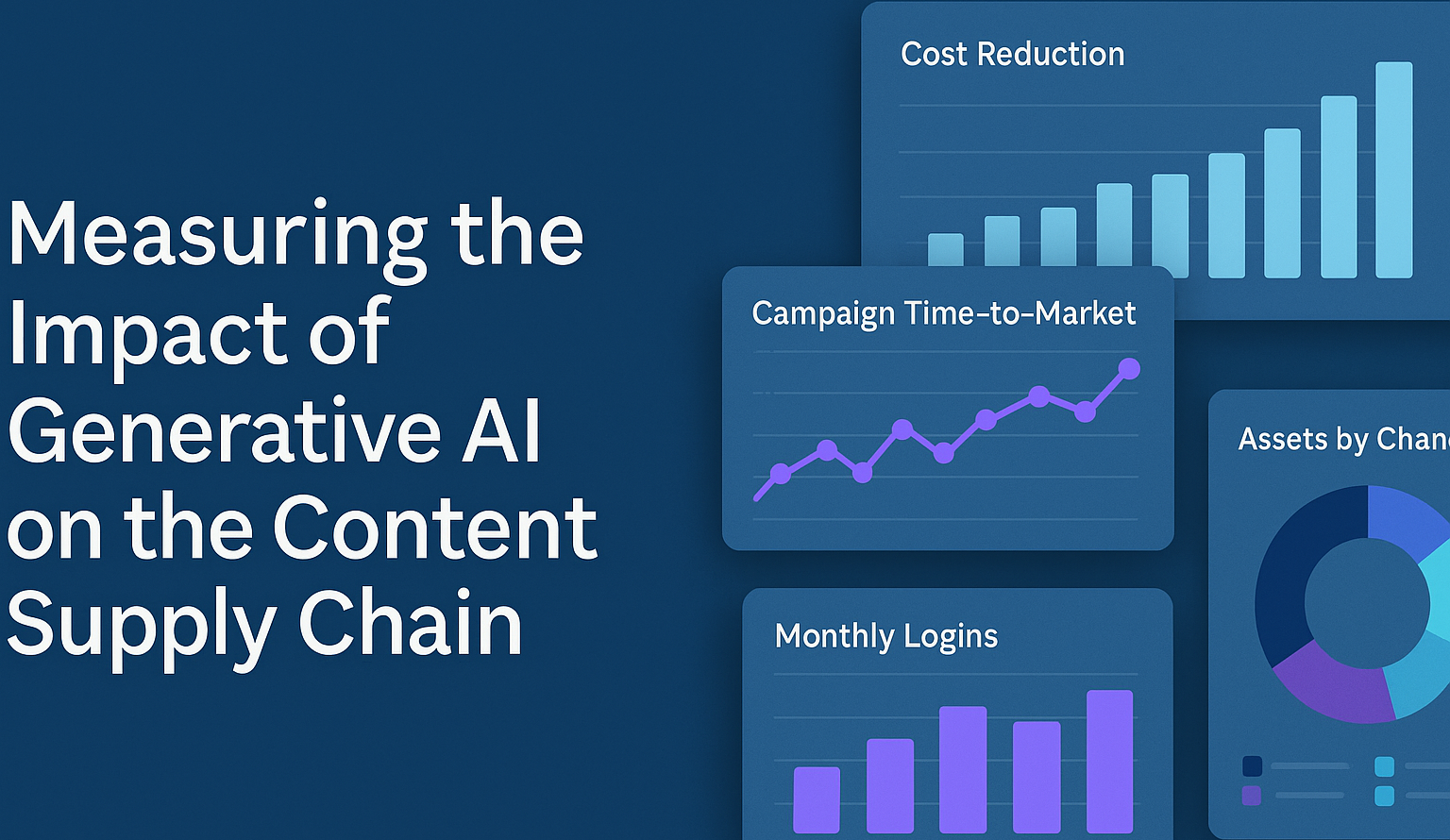
Every year, the same meetings show up on the calendar. Renewals. Budget alignment. Procurement reviews. The kind of meetings where marketing suddenly needs to explain itself in spreadsheets.
For a long time, content platforms struggled here. Not because they weren’t valuable, but because their impact lived in vague territory:
- “Teams feel faster”
- “Markets are happier”
- “Creativity scales better”
Nice. But not defensible.
This year felt different.
This year, renewal conversations became… easy.
Not because marketing became cheaper in theory — but because the content supply chain finally became measurable. And once AI entered that chain in a structural way, the P&L followed.
This is a story about what changed — and how to measure it properly.
The moment marketing stopped defending itself
In renewal conversations over the last few months, something remarkable happened.
CMOs didn’t talk about tools.
Heads of Ops didn’t talk about roadmaps.
Even creativity barely came up.
Instead, they showed tables.
They showed:
- Agency spend avoided
- Internal hours removed
- Campaign speed gains
- Market adoption curves
- Asset output per campaign
Not promises. Evidence.
This wasn’t because marketing suddenly became financial.
It’s because generative AI and automation finally moved upstream — into the mechanics of production, not just ideation.
From creative chaos to a measurable supply chain
Most marketing organizations still treat content like magic:
- someone asks for it,
- someone makes it,
- assets appear.
In reality, content is a supply chain:
data comes in,
- rules apply,
- formats multiply,
- markets localize,
- channels distribute.
Once you automate that system — and let AI work inside guardrails — measurement becomes unavoidable.
And powerful.
KPI category 1: direct cost taken out of the system
1. agency spend avoided
Let’s start with the bluntest metric: money not spent.
Most global brands still use agencies for mechanical execution:
resizing, localisation, format adaptation, price variants, channel versions.
Once that work moves into automated templates with AI assistance, the math changes immediately.
Sample KPI table
No creativity lost.
Just repetition removed.
And because campaigns repeat, this compounds fast.
2. internal production hours removed
This one is quieter — and often bigger.
Senior designers and marketers lose enormous time to operational work:
duplicating assets
updating formats
managing variants
re-exporting “one last change”
Automation plus AI removes the work without removing the people.
Calculation example
- Assets per campaign: 400
- Avg. production time before: 1.4 hours
- Avg. production time after: 0.35 hours
- Internal blended rate: €60/h
Savings per campaign:
(1.4 – 0.35) × 400 × 60 = €25,200
That’s not efficiency.
That’s reclaimed senior talent.
KPI category 2: speed that changes business outcomes
3. time to market
Campaign timing matters more than creative perfection.
Automation massively compresses the slowest parts of marketing: localisation, formatting, approvals.
Before vs after
Less wasted media.
Better price alignment.
Faster response to competitors.
This is where marketing operations starts impacting revenue, not just cost.
4. output per campaign (poi explosion)
Once assets are generated automatically from structured templates, output stops being constrained by human bandwidth.
Campaigns that once produced 20–30 assets now ship hundreds.
Sample output comparison
This isn’t “more content”.
It’s full channel coverage, finally affordable.
KPI category 3: global adoption & leverage
5. market onboarding & usage
The fastest test of value:
do markets actually use it?
Adoption snapshot
Adoption replaces enforcement.
That alone removes hundreds of manual coordination hours centrally.
6. daily active users (the stickiness test)
If a system matters, people log in.
User activity view

This is where renewal discussions change tone.
High DAU = infrastructure, not “one more platform”.
KPI category 4: risk eliminated (the invisible savings)
7. brand & legal error reduction
AI operating inside design systems doesn’t just accelerate — it enforces.
Prices. Disclaimers. Typography. Language rules. Channel constraints.
Error reduction example

No one applauds prevented mistakes.
Finance quietly does.
What this looks like in real dashboards
Executive renewal dashboard (1 slide)
Purpose: decide renewal without debate
- 💰 Total cost avoided YTD
- ⏱ Avg. time-to-market reduction
- 🌍 Active markets live
- 📦 Assets generated per campaign
- ✅ Platform cost vs savings ratio
This is the slide that ends negotiation.
CMO / marketing ops live dashboard
Purpose: prove operational leverage
Widgets
- Campaign throughput per month
- Channel coverage heatmap
- Automation coverage %
- Market self-service ratio
- AI-assisted asset rate
Translation: “we scaled without hiring.”
Finance / procurement dashboard
Purpose: justify budget in their language
Widgets
- Agency cost trend
- Freelancer dependency reduction
- Internal hours reclaimed
- Cost per asset trend
- ROI multiple
No storytelling needed. Numbers tell it.
Why this changed renewals forever
Generative AI didn’t magically “make marketing cheaper”.
It did something more important:
it forced marketing to behave like a system.
Once content production is automated, structured and rule-driven:
- effort becomes measurable
- waste becomes visible
- impact becomes defensible
That’s when the P&L starts listening.
The real takeaway
At the end of the year, renewal conversations usually feel political.
This year, they felt mathematical.
Not because creativity disappeared —
but because AI moved from ideation to execution, where business value actually lives.
When marketing can walk into finance with:
- hard savings,
- operational leverage,
- and system adoption proof,
the renewal isn’t a discussion.
It’s a continuation.
CEO insights

Kevin Goeminne
Dec 9, 2025
Sign up for blog updates
Related articles


