


Migrating from GraFx Publisher to GraFx Studio: A Practical Guide to Confident, Compliant Migrations
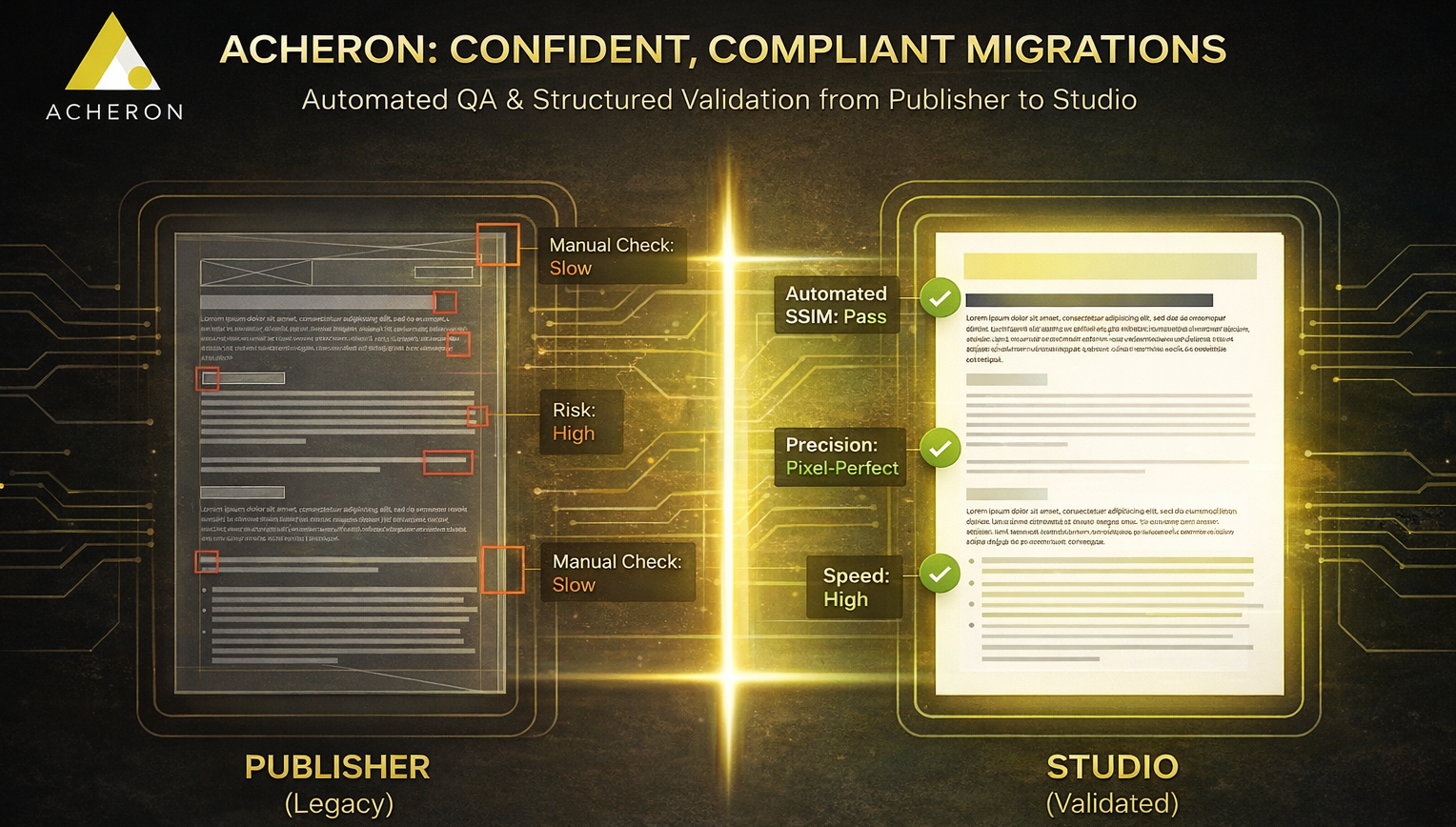
It is launch day for GraFx Studio. Production goes live. Your team has spent weeks preparing, migrating templates, validating outputs, and refining workflows. Now the first production orders come in. Templates perform exactly as expected. Tweaks are made to optimize a few details. Everything runs smoothly.
This is not luck. It is the result of a structured, phased migration approach that prioritized validation, planning, and continuous quality checks from day one.
For many teams transitioning from GraFx Publisher to GraFx Studio, success looks like this: confidence in production outputs, minimal surprises, and the ability to leverage GraFx Studio's full capabilities immediately after go-live.
This blog is not about why you should move to GraFx Studio; many teams already understand the benefits. Instead, it focuses on how to plan and execute migrations in a controlled, predictable manner that delivers production ready results.
Why Validation Deserves a Structured Approach
For most GraFx Publisher to GraFx Studio migrations, the technical conversion is not the hardest part. Validation is.
GraFx Publisher and GraFx Studio handle rendering, fonts, spacing, and layout logic differently. When migrating to a large template library, these differences can be subtle and may not appear during initial previews. They tend to surface later and sometimes during production runs.

Many teams begin by visually comparing GraFx Publisher and GraFx Studio outputs side by side.
This works initially, but it breaks down as scale increases:
- Manual checks are slow and difficult to sustain at pixel level precision
- Reviewer fatigue leads to missed inconsistencies
- Only a small portion of templates can be validated each day
- There is little or no record of what was validated and to what standard
This is why successful migrations treat validation as a structured process, not a final checklist item.
A structured validation approach typically means:
- Defining quality thresholds and acceptance criteria upfront
- Applying the same checks consistently across all templates
- Validating continuously throughout the migration, not just before go-live
- Detecting issues early, when they are faster and cheaper to fix
- Maintaining traceability to support compliance and stakeholder confidence
When validation is handled this way, migrations move faster, risks are reduced, and teams go live with GraFx Studio knowing their templates are production ready.
This need for consistency, scale, and traceability is what drives many teams to rethink how validation is done during migration.
What an Automated QA Mindset Looks Like
One effective way organizations reduce risk is by introducing objective, automated validation into the migration process.
Instead of asking designers to visually compare outputs one by one, automated image comparison techniques can be used to detect layout and rendering differences at scale. Methods such as Structural Similarity Index (SSIM) allow teams to compare GraFx Publisher and GraFx Studio outputs pixel by pixel and highlight even subtle changes.
In practice, this means:
- Small alignment shifts and spacing changes are detected automatically
- Font rendering and layout inconsistencies are flagged early
- Hundreds of templates can be validated per day, not per week
- Quality thresholds can be defined and applied consistently
- Failed templates are clearly marked with visual evidence of what changed
Just as importantly, every validation result is documented, creating traceability that supports compliance and internal confidence.
Automation does not replace design expertise. It removes repetitive validation work so teams can focus on fixing issues and improving templates rather than hunting for differences. For print heavy organizations, regulated industries, or teams managing hundreds of templates, this shift is often the difference between stressful migration and a controlled one.
A Five-Phase Way to Think About Migration
Rather than treating migration as a single technical task, it helps to think of it as a phased program, with validation running throughout.
Phase 1: Audit and Planning
Start by understanding your template library. Identify high risk and high impact templates, assess complexity, and align migration priorities with production timelines.
This is also the phase where consolidation opportunities emerge. GraFx Studio's architecture often allows multiple GraFx Publisher templates to be combined into a single, more flexible GraFx Studio dynamic layout.

Phase 2: Trial Migration and QA Setup
Migrate a representative sample first. This is where you confirm how GraFx Publisher and GraFx Studio behave differently and tune your validation approach before scaling.
Phase 3: Bulk Migration with Continuous Validation
Templates move in controlled batches, with QA checks running immediately after each batch. Issues surface early, not at go-live.
Phase 4: Go-Live Support
Final production templates are validated, rollout is controlled, and teams are supported during initial production runs to ensure smooth operations
Phase 5: Post-Migration Optimization
Once stability is achieved, teams can focus on leveraging GraFx Studio’s strengths, identifying templates that benefit most from automation, multichannel output, or data driven workflows.
The common thread across all phases is simple: automated quality checks and structured validation happen continuously, not at the end.
Unlocking GraFx Studio’s Value After Migration
Once migration is complete and validated, GraFx Studio enables a new level of creative efficiency.
Teams can:
- Design once and output across print, digital, and motion
- Use AI-assisted templates to reduce design effort
- Connect templates directly to DAM, PIM, ERP, or CRM data
- Apply governance and brand controls consistently
- Consolidate template libraries by replacing multiple static templates with fewer, more intelligent ones
These benefits only materialize if the migration itself is complete, stable, and trusted. Skipping validation or rushing through consolidation undermines the very advantages GraFx Studio is designed to deliver.
A Perspective from the Field
Over the past few years, we have supported GraFx Publisher to GraFx Studio migrations across a wide range of scenarios, from small pilot implementations to large, business critical transitions involving hundreds of templates and strict print standards.
What consistently separates smooth migrations from challenging ones is not the size of the library or the complexity of the templates. It is how well the migration is planned, implemented, validated, and supported through go-live.

Validation is a critical part of this journey, but it works best when it is tightly integrated with implementation, consolidation strategy, and operational readiness.
Much of what is described in this blog reflects patterns we have seen succeed repeatedly, especially in print heavy and regulated environments where quality, governance, and reliability are non-negotiable.
If you are planning a move from GraFx Publisher to GraFx Studio and want to sense, check your approach, understand potential risks early, or discuss both the implementation and validation aspects of your migration, we are always happy to share our experience.
Ultimately, successful GraFx Publisher to GraFx Studio migrations is less about speed and more about confidence. Teams that invest in thoughtful implementation and structured validation early rarely need to firefight later.
You can learn more on our website or reach us at contact@acheron-tech.com
Partners

Umesh Kumar Gope
Jan 21, 2026
Sign up for blog updates
Related articles

Product,
Marketing

Bram Verniest
Feb 25, 2026


